It’s the end of a trading day. A regional merchandising team notices inventory mismatches, delayed fulfillment updates, and missed BOPIS commitments. While AI can detect these signals, teams still struggle to act because the underlying systems remain disconnected. Integration platforms like Boomi provide the foundation for AI agents to respond, moving retail operations from insight-driven AI to agentic execution. Let’s see how this works.
The retail system execution gap and its real cost
Retail today is defined by frictionless customer experiences across channels, requiring omnichannel integration to connect inventory, orders, logistics, and customer data in real time. Yet many retailers still rely on fragmented data, batch-driven integrations, and slow decision cycles.
- $1.2 trillion is lost annually due to out-of-stocks1
- 47% of BOPIS customers worry items won’t be available at pickup2
These figures highlight the gap between what retailers can see and what their systems can execute in real time.
Why AI in retail alone is not enough?
Retailers are rapidly adopting AI to improve forecasting, pricing, and customer engagement. However, in many retail systems, AI still primarily serves as an insight layer, analyzing data and highlighting trends without influencing operational workflows. As a result, the gap between identifying issues and resolving them remains significant. This challenge is driving retailers toward a new operating model known as agentic retail.
What is agentic retail?
Agentic retail refers to retail operations where AI agents detect signals, coordinate workflows, and execute decisions automatically across connected systems. Instead of relying on manual intervention, these agents can respond to events in real time.
How Boomi integration enables agentic retail?
Enabling agentic retail requires systems that can react as quickly as insights emerge. Retail platforms, including inventory, order management, fulfillment, and customer systems, must operate as a connected ecosystem.
Boomi lays the foundation by connecting systems, data, and workflows across the retail environment. This integration enables AI agents to coordinate actions and execute decisions in real time.
With this connectivity, retailers can advance from analytical AI to agentic retail, where operational responses occur automatically across the business. In practice, AI agents in retail operate through a continuous operational flow:
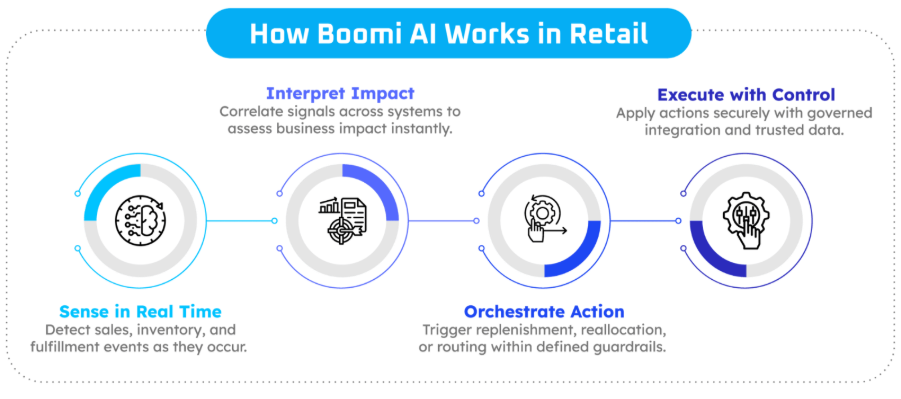
“Retailers already have the data and the insights. The competitive advantage now lies in how quickly those insights turn into operational action. The LevelShift Boomi Agentic AI Retail Framework enables AI agents to coordinate responses across retail systems in real time.” — Dhanasekaran Vasudevan, AVP Enterprise Integration, LevelShift.
LevelShift’s Boomi Agentic AI Retail Framework
To operationalize agentic retail, LevelShift offers the Boomi Agentic AI Retail Framework. It brings together event-driven integration, EDI automation, API governance, trusted data management, and AI agents with enterprise governance, enabling intelligence to flow directly into day-to-day retail operations.
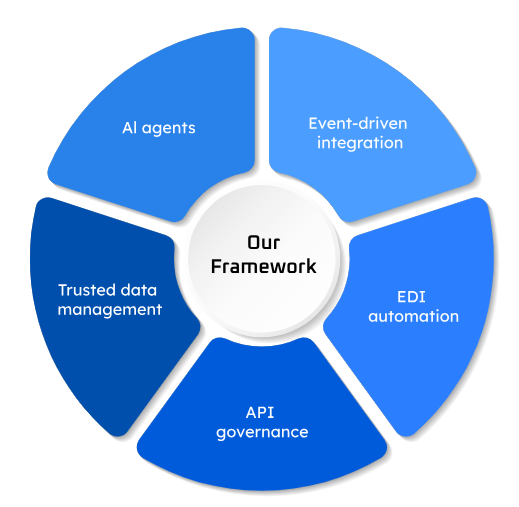
LevelShift consolidates these features into one service to transform retail operations, delivering omnichannel integration, advanced supply chain agility, and AI-driven orchestration at an enterprise scale.
Boomi AI Agents in Retail: How the Agentic Framework powers retail operations
While the framework establishes the integration foundation, its true value emerges through the Boomi AI agents operating within it. The following scenario illustrates how LevelShift’s Boomi Agentic AI Retail Framework connects retail systems and enables AI agents to act across the entire retail journey.
Imagine the start of a major promotional day for a national retailer. New products are launching, suppliers are onboarding, and customers are already browsing online before stores even open. Behind the scenes, multiple systems must coordinate inventory, supplier data, orders, fulfilment, and customer information in real time.
9:00 AM — Supplier onboarding before store opening
A new supplier must be onboarded before the promotion begins. Traditionally, this process involves manual document validation and EDI configuration, delaying inventory availability. With LevelShift’s Boomi retail framework, supplier documents are exchanged, validated, and integrated automatically.
AI agents coordinate onboarding workflows:
- The Supplier Onboarding Assistant guides the partner through onboarding workflows.
- Supplier Fraud and Authenticity Detector verifies credentials and flags potential risks.
Impact: 40–60% faster supplier onboarding and faster time-to-shelf.
11:30 AM — Omnichannel demand surges
As the promotion launches, orders start coming in through ecommerce, mobile apps, and physical stores. Using LevelShift’s event-driven Boomi integration architecture, demand signals from POS, ecommerce, and ERP systems are captured instantly.
AI agents coordinate operational responses:
- Omnichannel Order Coordinator routes orders to the best fulfillment location.
- Inventory Replenishment Agent reallocates stock across warehouses and stores.
- Lead-to-Cash Agent synchronizes order and revenue workflows.
Impact: 30–50% faster omnichannel execution.
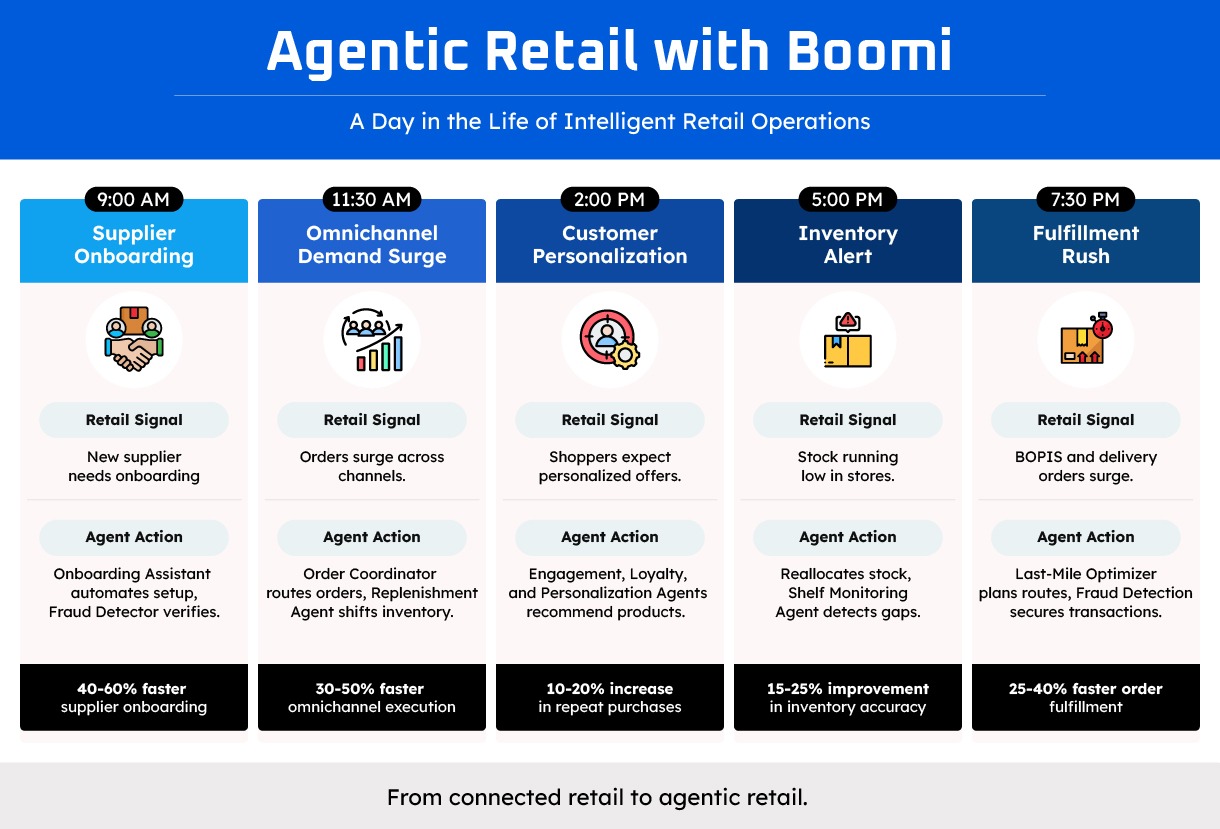
2:00 PM — Personalization at scale
By the afternoon, returning customers expect personalized offers and loyalty rewards. However, customer data is often fragmented across marketing, commerce, and loyalty systems. LevelShift uses Boomi’s trusted data management and API governance capabilities to unify customer data across the retail ecosystem.
AI agents then activate this data in real time:
- Engagement Agent detects behavioral signals.
- Loyalty Agent applies rewards automatically.
- Personalization Agent recommends relevant products and offers.
Impact: 10–20% increase in repeat purchase value.
5:00 PM — Inventory pressure builds
As demand persists, some stores run out of popular products while excess inventory sits in nearby warehouses. The AI Retail Framework promptly detects inventory signals.
AI agents intervene before stockouts impact revenue:
- Inventory Agent maintains real-time stock visibility.
- The Shelf Monitoring Agent detects low store inventory.
- Inventory Replenishment Agent triggers stock transfers.
Impact: 15–25% improvement in inventory accuracy.
7:30 PM — Fulfillment at peak speed
By evening, hundreds of BOPIS and ship-from-store orders must be fulfilled quickly. Event-driven integration and API governance connect order, inventory, and logistics systems, allowing signals to flow instantly across the retail environment.
AI agents coordinate fulfillment and delivery decisions in real time:
- Omnichannel Order Coordinator selects the optimal fulfillment location.
- Last-Mile Delivery Optimizer determines the fastest delivery route.
- Order Fraud Detection Agent verifies transactions before fulfillment.
Impact: 25–40% faster fulfillment.
Across this promotional day, LevelShift’s Boomi Agentic AI Retail Framework captures operational signals across retail systems while AI agents interpret them and coordinate responses.
As AI becomes more embedded in retail operations, the focus is shifting from generating insights to executing decisions in real time. This raises key questions for retail organizations:
- Are our AI initiatives enabling systems to act automatically or just interpret data?
- Where could Boomi AI agents respond to retail signals faster than humans could make decisions?
- Are our retail systems integrated enough for AI to coordinate actions across channels?
- What would it take to move from insight-driven AI to agentic retail execution?
If these questions sound familiar, you are already on the path toward agentic retail.
Start a conversation with our Boomi experts to identify where AI agents and integrations can enable agentic retail across your retail landscape.
FAQs
How Boomi AI is used to integrate retail systems?
Boomi AI integrates retail platforms by connecting inventory, POS, e-commerce, logistics, and supplier systems through APIs, EDI, and event-driven integration.
What are the benefits of Boomi AI agents in retail?
Boomi AI agents assist retailers automate operational decisions by detecting events, orchestrating workflows, and executing actions across connected systems. This improves inventory visibility, order fulfilment speed, and supply chain coordination.
What are the types of Boomi AI agents used in retail?
Common Boomi AI agents in retail include inventory monitoring, supplier onboarding, order orchestration, fulfilment optimization, and customer engagement. These agents analyze operational signals and trigger automated actions across retail systems.
What are the best practices for managing EDI systems in retail?
Retail EDI management best practices include standardizing EDI formats, automating partner onboarding, monitoring transactions in real time, and integrating EDI with ERP, inventory, and supply chain systems.
How do retail businesses use agentic AI for personalization?
Retail businesses use agentic AI for personalization by analyzing customer behavior and intent in real time. AI agents then automatically deliver tailored offers, product recommendations, and loyalty rewards across channels.