Data Modernization Services
Enable the right data foundation to power your AI journey.
Are your AI ambitions limited by a weak data foundation?
Organizations launch AI pilots but struggle to move beyond experimentation. Without standardized, integrated, and reliable data, models fail to operationalize, stalling analytics programs, delaying ROI, and limiting AI.
Is fragmented data slowing decisions and increasing cost?
Siloed systems and inconsistent datasets erode trust in insights while driving up licensing, storage, and operational overheads. Fragmentation slows real-time analytics and reduces the impact of AI-driven use cases.
Are governance and compliance gaps putting data at risk?
As data volumes grow, weak governance creates quality issues, rework, and regulatory exposure. Without strong controls, analytics adoption slows and AI initiatives struggle to scale securely and responsibly.
Accelerate AI Outcomes with Modern Data and AI Services
Gartner predicts that through 2026, organizations will abandon 60% of AI projects unsupported by AI-ready data.
We deliver enterprise-grade Data and AI services with our exclusive LevelShift Data Modernization Framework (LDMF). LDMF is a proven methodology for data modernization, structured across three layers: Foundation, Transformation, and Activation. LDMF is designed to cover the full lifecycle, from data strategy and cloud infrastructure through engineering and governance, to analytics, AI/ML, and intelligent applications.
Equally important, it is built to meet you wherever you are in the journey. Whether you are building from the ground up, modernizing existing pipelines, or accelerating toward AI readiness, LevelShift brings cross-layer expertise to move you forward faster and with less risk.
Schedule a Call
The LevelShift Data Modernization Framework (LDMF)
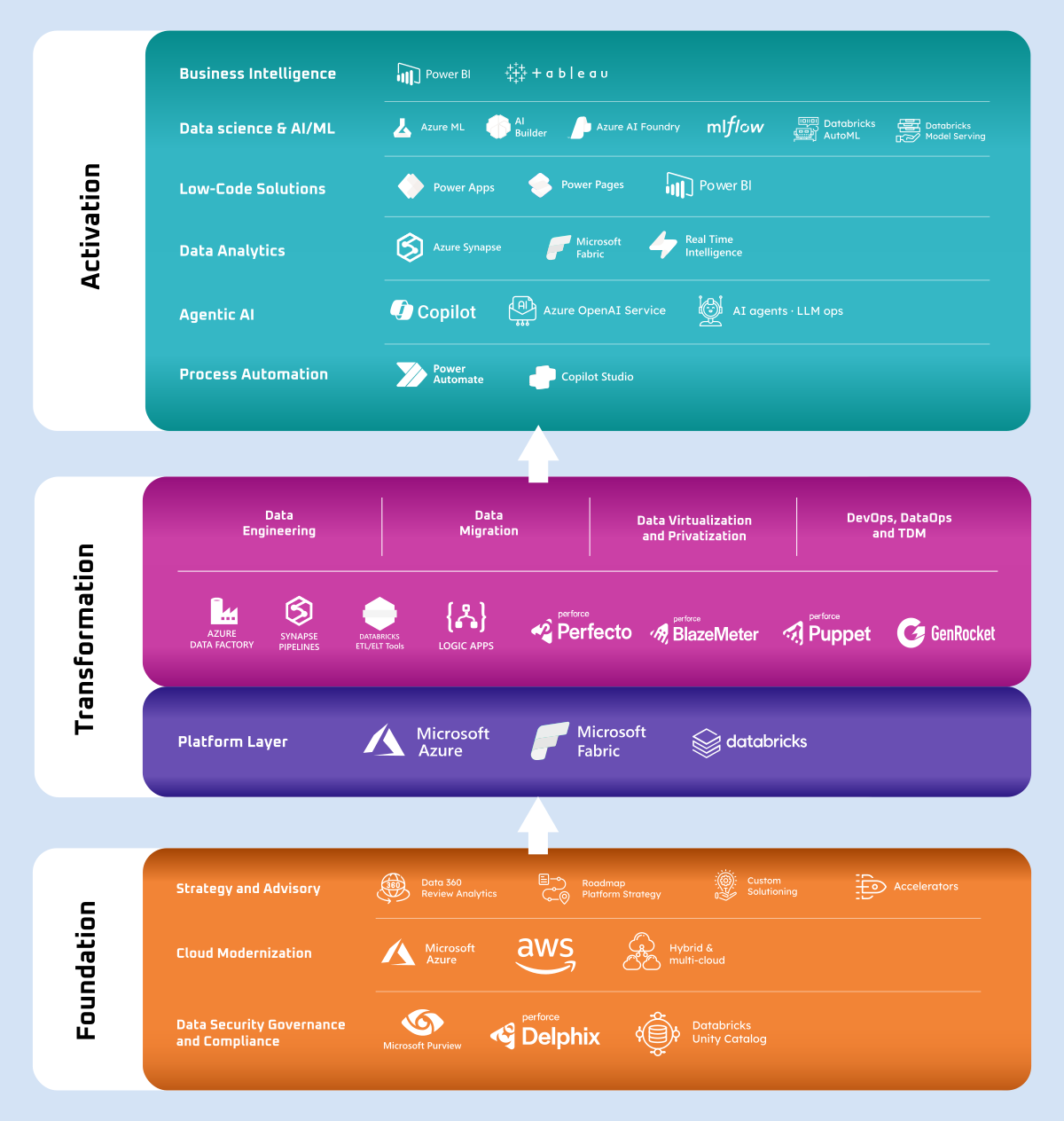
Our Data Modernization Services
Strategy and Advisory Services
Realize the full potential of your data and apps with our Data360 Opportunity Scan. We assess your data landscape, tech stack, governance, and technical debt to define your Analytics Roadmap, Data Strategy, and Platform Strategy—accelerating AI and modernization outcomes.
Cloud Adoption Services
Accelerate modernization with Azure and AWS native architectures that simplify migration and optimize performance. We re-platform workloads, containerize data assets, and ensure scalability with cloud native tools, enabling agility, elasticity, and a lower total cost of ownership.
Data Governance and Compliance Services
Build trusted, compliant, and business-ready data foundations with Microsoft Purview, Databricks Unity Catalog, AWS governance services, and Perforce Delphix. We enable secure governance, lineage, policy control, and automated compliance for GDPR, HIPAA, CCPA, and PCI-DSS.
Data Security Services
Protect enterprise data across hybrid and multi-cloud environments using Purview, Perforce Delphix, Databricks, and AWS security services — delivering encryption, data masking, RBAC, and zero-trust frameworks across production and non-production environments.
Talk to the experts who will actually build your data foundation


LevelShift Accelerators and Frameworks
Our data transformation strategies, accelerators, and frameworks fast-track data modernization, enabling organizations to unlock insights, optimize processes, and drive value across industries. From domain-specific Power BI and Microsoft Fabric solutions to seamless Tableau migrations, our pre-built accelerators reduce implementation time and ensure rapid, measurable outcomes.
Power BI Industrial Insights Accelerators
Microsoft Fabric Accelerators
Tableau to Power BI Migration Accelerator
Building an AI-Ready Retail Data Foundation
For SPINX, fragmented systems and manual data processes, limited visibility into operations and promotional performance. By modernizing the analytics ecosystem across Azure Synapse, Power BI, and Microsoft Fabric, data was unified into a centralized, governed platform.
Read the full story60% Faster Access to Insights
Reduced reporting time by enabling teams to analyze promotions and item performance in near real time.
40% Reduction in Manual Effort
Consolidated multiple systems into a single platform, eliminating silos and improving data accessibility.
30% Improvement in Data Reliability
Established a governed data foundation to ensure accuracy, consistency, and readiness for AI use cases.
Why LevelShift
- Microsoft Solution Partner with 100+ certified professionals
- Microsoft Fabric Featured Partner with 50+ Fabric-certified experts
- 100+ Successful Data Transformation delivered
- WINNER Top 10 Data and Analytics Team Awards
- A strategic Databricks Partner



Customer Testimonials
FAQs
Data modernization is the process of upgrading legacy data systems to modern, cloud-native platforms that support real-time analytics, scalability, governance, and AI readiness. Common examples include migrating legacy databases to Microsoft Fabric, Databricks, Snowflake, or Azure Synapse, modernizing ETL pipelines, and replacing static reports with Power BI dashboards.
According to McKinsey’s State of AI 2025, 88% of organizations now use AI in at least one business function, highlighting the growing need for modern data foundations.
Data migration focuses on moving data from one system to another. Data modernization is broader — it transforms your architecture, pipelines, governance, and analytics capabilities to support long-term scalability and AI readiness.
Migration is often one step within a larger modernization initiative.
The most common challenges organizations face include:
- Poor data quality and inconsistent legacy data
- Complex legacy systems with undocumented dependencies
- Data silos that limit unified analytics and AI adoption
- Skill gaps in cloud and data engineering expertise
- Misalignment between data strategy and business goals
- Governance, security, and compliance requirements
- Budget overruns and extended project timelines
- Business continuity risks during migration
- Resistance to new tools and operating models
- Gaps in AI readiness and modern data capabilities
At LevelShift, we address these challenges through our comprehensive Data Modernization Services and our exclusive LevelShift Data Modernization Framework.
Project timelines depend on scope and complexity. Smaller migrations can take 6-9 months, while enterprise-wide modernization programs often span 18-24 months and are delivered in phases.
According to BCG, two-thirds of large-scale technology programs miss targets related to time, budget, or scope, often due to planning and execution challenges rather than technology limitations.
Get started with Our Data Modernization Consulting Services to get an estimate.
Costs can range from tens of thousands of dollars for smaller projects to several million for enterprise-wide transformation programs. Key factors include data volume, platform licensing, migration complexity, governance, and training requirements.
Organizations commonly achieve 20-50% reductions in infrastructure and operational costs after modernization.
Security should be built into every stage of modernization. Best practices include encrypting data at rest and in transit, implementing role-based access controls (RBAC), masking sensitive data, isolating environments, and continuously monitoring workloads during migration.
Organizations should also validate compliance requirements such as GDPR, HIPAA, and CCPA before and after migration.
The 7 R's are a framework used to define modernization strategies for applications and workloads:
- Rehost
- Relocate
- Repurchase
- Replatform
- Refactor
- Retain
- Retire
The framework helps organizations prioritize modernization efforts based on business goals, cost, and complexity.
Data mesh is a decentralized data architecture approach built on four principles:
- Domain ownership
- Data as a product
- Self-serve infrastructure
- Federated computational governance
Platforms like Databricks and Microsoft Fabric increasingly support data mesh implementations through unified governance and self-service analytics capabilities.
Microsoft End Customer Investment Funds (ECIF) is a co-investment program that helps organizations accelerate adoption of Microsoft technologies such as Azure, Microsoft Fabric, Power BI, and Azure OpenAI.
Funding is managed through approved Microsoft partners who handle project scoping, application, and delivery. As a Microsoft partner, LevelShift can help assess eligibility, align projects to Microsoft funding priorities, and manage the end-to-end ECIF process.
Qualifying project types include Azure migrations, Fabric and Power BI deployments, Azure OpenAI solutions, and security modernization. (Microsoft Partner Program, 2025)