Cloud Adoption Services and Data Warehousing
Migrate to the cloud and modernize your data warehouse for AI, advanced analytics, and real-time insights.
Held back by legacy infrastructure that cannot scale with data demand?
We move enterprises from rigid on-prem systems to elastic, secure cloud architectures built for modern data and AI workloads, so your data estate scales without disruption.
Struggling to unify data across a fragmented multi-cloud estate?
We architect and implement high-performance, governed data platforms across leading cloud ecosystems, consolidating siloed data into a unified foundation that powers consistent BI, AI, and analytics across your enterprise.
Concerned about governance, compliance, and runaway cloud spend?
Our cloud adoption frameworks embed governance controls, FinOps practices, compliance safeguards, and automated monitoring from day one. Every migration is engineered for zero-to-low downtime.
Modernizing Cloud Adoption and Data Warehousing
IDC forecasts cloud infrastructure spending to grow 33.3% in 2025 to $271.5 billion, while non-cloud infrastructure is expected to decline 4.9%—highlighting the accelerating shift toward cloud environments that power modern AI and analytics workloads. Many enterprises struggle to migrate from legacy infrastructure, fragmented systems, and traditional data warehouses that limit scalability, agility, and real-time decision-making.
LevelShift is a Microsoft Solutions Partner for Azure (Infrastructure), a Microsoft Specialized Partner for Data Warehouse Migration, and a strategic Databricks partner. We help organizations plan, migrate, modernize, and optimize cloud environments across Azure, AWS, and multi-cloud ecosystems with minimal disruption. Our services also help enterprises centralize data, improve reporting, and enable real-time analytics across the business.
Schedule a Call
Redesigning Data Foundations for Cloud and Analytics
With LevelShift, cloud adoption goes beyond a basic lift and shift. We help enterprises rebuild their data foundations to be cloud-native, governed, and ready for analytics across Azure, AWS, and multi-cloud environments.
Cloud-native data architectures
Purpose-built for performance, scalability, and cost-efficiency across Azure, AWS, and multi-cloud environments using modern cloud-native design patterns and proven enterprise best practices.
Unified data models and governed warehouses
Deliver consistent BI, AI, and advanced analytics through governed data models built on Microsoft Azure, Databricks Lakehouse, and Microsoft Fabric OneLake across your entire data ecosystem.
Flexible, secure landing zones
Enterprise-ready landing zones across Azure, AWS, and hybrid-cloud environments, with security, governance, compliance, and access controls structured to meet regulatory and operational requirements at scale.
Our Cloud Migration and Data Warehousing Services
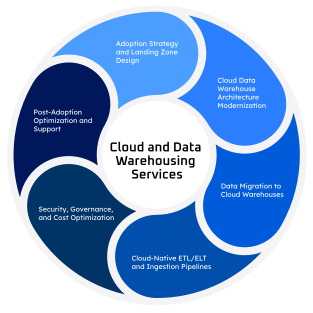
Adoption strategy and landing zone design
Cloud data warehouse architecture modernization
Data migration to cloud warehouses
Cloud-native ETL/ELT and ingestion pipelines
Security, governance, and cost optimization
Post-adoption optimization and support
Talk to the experts who will architect, migrate, and optimize your cloud data platforms


Our Cloud Adoption Services Approach
Assess workloads, data systems, risks, and total cost of ownership.
Architect cloud warehouses, integration patterns, and governance controls.
Deploy cloud platforms, pipelines, and storage architectures.
Validate workloads, reconcile data, optimize performance, and benchmark.
Scale adoption with BI, AI, semantic models, and usage insights.
Govern cloud operations with policies, monitoring, and continuous optimization.
Enabling a Title Insurance Company with Enterprise Cloud Migration and Operational Excellence
Facing high infrastructure costs, manual workflows, and legacy on-premises dependencies, the client migrated to Microsoft Azure. Legacy systems were re-platformed, pipelines automated, and document processing modernized for speed and compliance.
Read the full story40% Faster Request Processing
Automated document recognition and parallel search reduced processing time significantly across settlement workflows.
35% Reduction in Infrastructure Costs
Migrating from on-premises to Azure eliminated hardware overhead and dedicated server maintenance costs.
45% Improvement in Operational Efficiency
Re-platformed workflows and automated pipelines streamlined operations and improved compliance readiness.
Why LevelShift
- Microsoft Solutions Partner for Infrastructure (Azure)
- Amazon Strategic Partner for cloud migration and cloud-native architecture services
- Microsoft Specialized Partner for Data Warehouse Migration and a strategic Databricks partner
- Faster, secure cloud migrations and optimized cloud storage powered by Perforce Delphix expertise



Where are you in your Data Transformation Journey?
Learn More