Data Migration Services
Enabling efficient, secure data migration across databases, ERPs, CRMs, and enterprise applications.
Struggling to migrate data siloed across systems and departments?
Data is assessed, rationalized, and re-engineered by modernizing ETL logic, resolving schema conflicts, and aligning data models to target platforms to produce clean and migration-ready data.
Need continuity, security, and compliance during critical migrations?
Migrations are executed in controlled phases using parallel runs, rollback mechanisms, data validation checks, and embedded governance to maintain business continuity, regulatory adherence, and zero data loss.
Unable to move data across on-prem, private or multi-cloud ecosystems?
End-to-end data movement is coordinated through hybrid connectivity, platform-native tooling, and format optimization to enable consistent and secure transfers across diverse cloud and on-prem environments.
Modern Data Foundations, Powered by Confident Migration
Data migration is more than just moving data. It is about preserving data quality, lineage, governance, and trust. These capabilities are becoming increasingly critical as Gartner predicts that, through 2026, organizations will abandon 60% of AI projects due to a lack of AI-ready data.
Our experts address the complexities of migration by reconciling data inconsistencies, modernizing schemas, enforcing governance, and ensuring every record reaches the target environment with integrity. We enable seamless migrations to Microsoft Fabric, Azure, Databricks, and modern data estates, delivering clean, compliant, high-fidelity data that is ready for analytics, AI, and downstream applications.
Schedule a Call
De-Risking Your Data Migration
Legacy systems carry years of complex logic, integration dependencies, and hidden data quality issues. Without a structured migration plan, the risks multiply: inconsistent data, downtime, broken processes, security gaps. LevelShift's Migration Framework solves this by combining them into one cohesive journey.

Data Discovery and Profiling
Understand current environments, assets, dependencies, and risks.

Quality Checks and Validation
Identify inconsistencies, duplicates, anomalies, and data gaps.

Schema and Mapping Design
Convert legacy structures to cloud-native formats.

Cleansing and Standardization
Standardize values, formats, rules, and master data domains.

Validation and Reconciliation
Ensure correctness, completeness, and referential integrity across systems.
Data Discovery and Profiling
Understand current environments, assets, dependencies, and risks.
Quality Checks and Validation
Identify inconsistencies, duplicates, anomalies, and data gaps.
Schema and Mapping Design
Convert legacy structures to cloud-native formats.
Cleansing and Standardization
Standardize values, formats, rules, and master data domains.
Validation and Reconciliation
Ensure correctness, completeness, and referential integrity across systems.
Our Data Migration Services
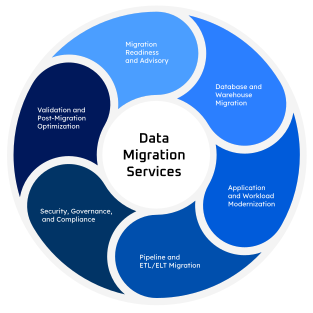
Migration Readiness and Advisory
Database and Warehouse Migration
Application and Workload Modernization
Pipeline and ETL/ELT Migration
Security, Governance, and Compliance
Validation and Post-Migration Optimization
LevelShift's End-to-End Migration Methodology
Environment inventory, profiling, dependencies, risks
Migration waves, landing zone design, T-shirt sizing
Schema conversion, ETL rebuild, cloud-native transformations
Secure transfer, parallel runs, validation
Hardening, optimization, governance setup
Ongoing support, monitoring, FinOps
End-to-End Migration from Legacy Analytics to a Modern Cloud Platform
The client needed to overcome infrastructure limitations, rising BI licensing costs, and fragmented reporting. LevelShift modernized the analytics ecosystem by migrating on-premises databases and SSRS workloads to Azure while consolidating the reporting landscape across Power BI, Sisense, and Tableau. The result was a scalable, governed analytics platform with lower costs and improved reporting efficiency.
Read the full story40% Lower BI Licensing Costs
Optimized BI costs by consolidating reporting across Power BI and Tableau while reducing reliance on Sisense.
55% Greater Reporting Automation
Automated reporting workflows by modernizing data and analytics on Azure.
Modern, AI-Ready Cloud Analytics Platform
Delivered a scalable, governed analytics foundation for self-service reporting and future AI initiatives.
Why LevelShift
- Zero-Disruption Framework - Phased, low-downtime approach
- Cloud-Agnostic Expertise - Azure, Fabric, Hybrid, Multi-cloud
- Migration Accelerators - Discovery automation, validation scripts, schema conversion templates


Where are you in your Data Transformation Journey?
Learn More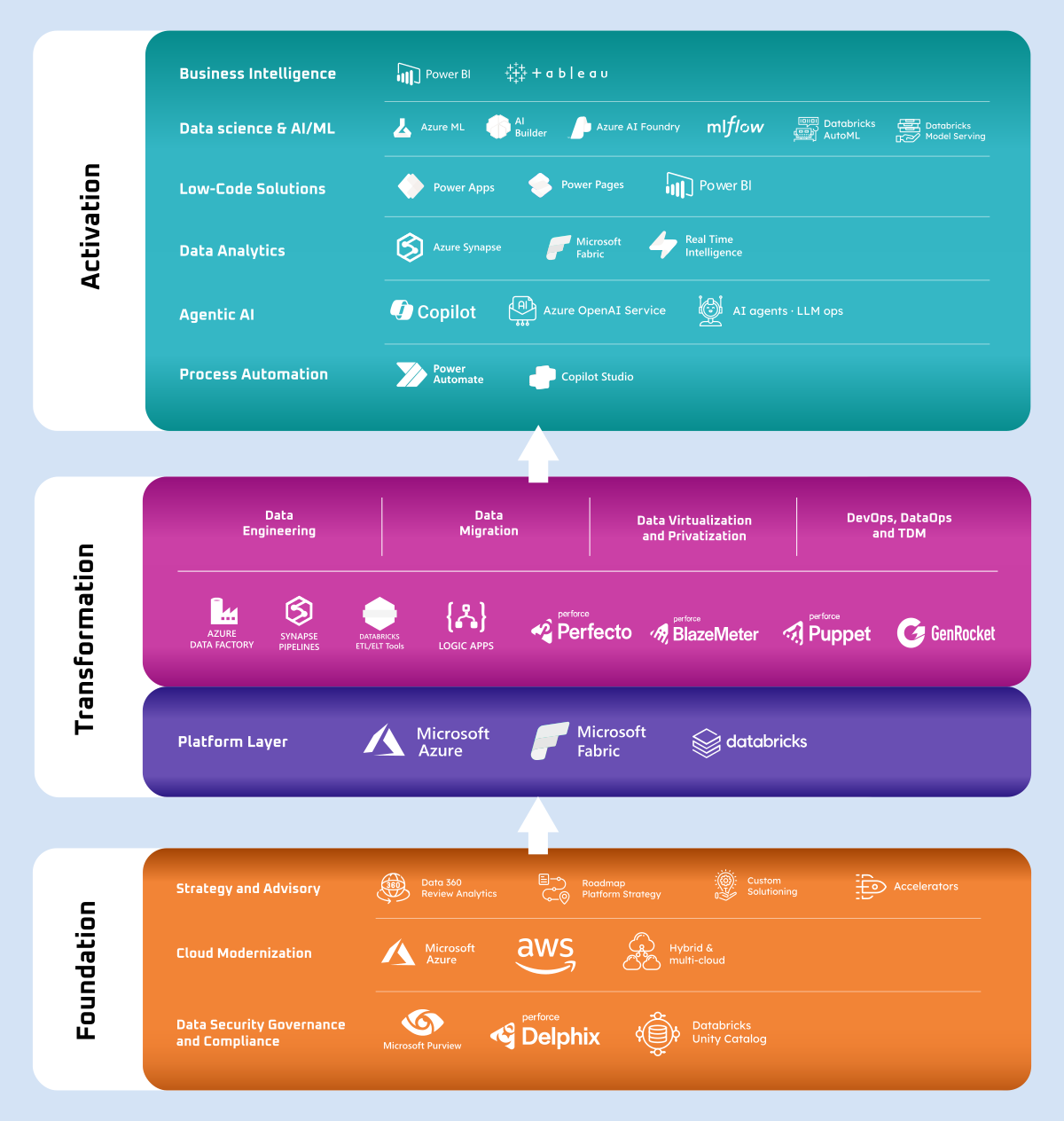
FAQs
Data migration is the process of moving data from one system, application, database, or platform to another while preserving its accuracy, integrity, and usability. It is often required during cloud adoption, application modernization, mergers, platform upgrades, or data center consolidation. A well-executed migration ensures business continuity, improves data quality, supports regulatory compliance, and creates a trusted data foundation for analytics, AI, and operational decision-making.
Successful data migration requires careful planning, phased execution, and continuous validation. At LevelShift, we use migration waves, parallel runs, rollback strategies, automated validation checks, and reconciliation processes to ensure data is transferred accurately while minimizing disruption. This approach helps maintain business continuity, reduces migration risks, and ensures critical applications remain available throughout the migration.
The duration of a data migration project depends on factors such as data volume, source and target platforms, application complexity, data quality, and integration requirements. Smaller migrations may take a few weeks, while enterprise-scale transformations can span several months. We begin every engagement with a migration readiness assessment to define the scope, identify dependencies, and build a phased migration roadmap that minimizes risk and accelerates delivery.
Common migration risks include data loss, inconsistent or duplicate records, schema mismatches, broken integrations, security vulnerabilities, compliance issues, and unexpected downtime. These challenges can delay projects and impact business operations. LevelShift mitigates these risks through comprehensive data profiling, cleansing, mapping, governance, validation, and controlled migration processes that ensure data remains complete, secure, and reliable throughout the transition.
LevelShift supports migrations across databases, data warehouses, enterprise applications, analytics platforms, and cloud environments. We help organizations migrate from legacy and on-premises systems to modern platforms such as Microsoft Fabric, Azure, SQL Server, Oracle, Snowflake, Databricks, Power BI, Dynamics 365, and hybrid or multi-cloud architectures. Our approach preserves business logic, data integrity, and governance while modernizing the underlying data ecosystem.
Data migration focuses on securely moving data from one environment to another while maintaining accuracy and continuity. Data modernization goes further by transforming data architectures, modernizing pipelines, improving governance, optimizing performance, and preparing data for advanced analytics and AI. Migration is often one phase of a broader modernization initiative that enables organizations to fully realize the value of cloud-native platforms and intelligent data ecosystems.
Data validation is performed before, during, and after migration to ensure every record is transferred correctly. LevelShift uses automated reconciliation, record count verification, referential integrity checks, schema validation, business rule testing, and exception reporting to confirm data accuracy and completeness. This structured validation process helps identify discrepancies early, reduces business risk, and ensures confidence in the migrated data before systems go live.