Supplier Fraud & Authenticity Detector Agent
RetailCopilot
Detects fake invoices, manipulated purchase orders, and fraudulent supplier documents using machine learning and anomaly detection to ensure supplier authenticity and reduce risk.
Pre-built Copilot agents
Industry-specific Copilot agent blueprints
Custom Copilot enablement workshop
Copilot in Microsoft Fabric is a generative AI assistant embedded natively across Data Factory, Lakehouse, Power BI, Data Warehouse, Real-Time Intelligence, and Data Science. It operates directly within your data platform, grounded in your organization's metadata, schemas, and workspace context rather than generic web knowledge.
Because Copilot consumes Fabric Capacity Units (CUs), governance and workload management are essential to prevent AI usage from competing with platform performance.
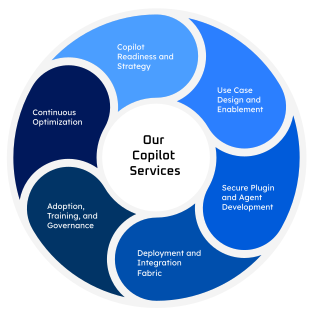
LevelShift helps organizations move from experimentation to production through use case prioritization, agent development, governance alignment, and adoption services, backed by certified Fabric expertise and enterprise-ready agent accelerators.
Teams do not know what Copilot can do in their specific workload. Without a curated use-case map, adoption stalls at the demo stage.
Copilot grounds responses in your metadata and schemas. If your lakehouse is messy or undocumented, outputs are unreliable, and trust collapses.
Teams disable Copilot at the tenant level due to unclear data residency or Purview-alignment questions, especially in regulated industries.
Copilot is limited to what lives inside your Fabric environment. Without REST plugins or custom connectors, business-critical context in your ERP, CRM, or proprietary systems stays out of reach.
Copilot uses Fabric Capacity Units (CUs). Teams enable it without monitoring, then hit capacity throttling mid-sprint. Cost modeling is skipped until it hurts.
Detects fake invoices, manipulated purchase orders, and fraudulent supplier documents using machine learning and anomaly detection to ensure supplier authenticity and reduce risk.
Analyzes product and order data to predict which items are most likely to be returned, enabling retailers to reduce logistics and restocking costs.
Optimizes delivery routes to reduce expenses, shorten travel times, and improve fuel efficiency, while maintaining compliance with service-level commitments.
Analyzes in-store camera and Wi-Fi data to create customer movement heatmaps, supporting store layout improvements and merchandising strategies.
Identifies the ideal SKU mix for each store, region, or season by analyzing demand patterns, trends, and shelf performance to maximize sales and inventory efficiency.
Dynamically creates product bundles and promotional offers to maximize conversion, profit margin, and customer engagement.
Monitors market price fluctuations, inventory levels, and demand signals in real time to recommend price adjustments.
Aggregates POS data, foot traffic, and shrinkage metrics to surface store-level anomalies and flag underperformers.
Ties demand forecasts, vendor lead times, and distribution schedules together, proactively surfacing stockout risks and overstock positions.
Allows customers to virtually try on garments or accessories using AR and AI-generated simulations with camera or 3D body mapping to enhance the shopping experience.
Try our custom Agent in a Day workshop. In this structured one-day engagement, our AI engineers work alongside your team to identify high-value Copilot use cases, define the right agent architecture, and build a working prototype within your Microsoft Fabric environment.