Power BI to Microsoft Fabric Migration Services
Modernize analytics and realize greater ROI with our secure and structured migration services.
Fabric Advantage #1:
SQL & Unstructured Data
With Data Flow Gen2, Fabric natively unifies SQL and unstructured data handling, unlike Power BI which primarily supports structured sources.
Fabric Advantage #2:
Built-in Data Governance
Power BI lacks native governance, while Fabric integrates Purview for consistent data management and compliance.
Fabric Advantage #3:
Assistance with Copilot
Unlike Power BI, Fabric includes Copilot, offering AI-driven insights and automation to accelerate analytics and decision-making.
Power BI vs. Microsoft Fabric: From Insights to Intelligence
Choosing between Power BI and Microsoft Fabric depends on your analytics maturity, data strategy, and AI goals. While Power BI is purpose-built for interactive reporting and visualization, Microsoft Fabric unifies data engineering, data science, real-time analytics, governance, and AI into a single SaaS platform.
According to a Forrester Total Economic Impact™, organizations adopting Microsoft Fabric achieved a 379% ROI over three years. As a Microsoft Fabric Featured Partner, LevelShift enables low-risk migrations by modernizing the data layer into a governed Medallion Lakehouse on OneLake, allowing existing Power BI reports to be repointed rather than rebuilt.
Note: Microsoft retired Power BI Premium (P SKUs) in January 2025. Organizations using Premium capacities must migrate to Microsoft Fabric (F SKUs) at renewal.
Schedule a Call
Key Power BI to Fabric Transition Challenges We Solve
Architecture & Feature Mapping
Mapping datasets, reports, dashboards, and Premium features to Fabric's lakehouse, warehouse, and dataflow architecture with full functionality preserved.
Data Governance & Security Alignment
Reconfiguring workspace permissions, row-level security, and compliance policies using Fabric's integrated Purview governance framework.
Dataset & ETL Compatibility
Migrating complex DAX measures, custom visuals, Power Query dataflows, and upstream ETL pipelines while ensuring data integrity and performance.
Performance & Capacity Planning
Optimizing Fabric compute, storage, and query performance for large datasets and enterprise workloads.
User Adoption & Change Management
Training teams, maintaining dashboard continuity, and redesigning workspaces to minimize disruption during migration.
Our Power BI to Fabric Migration Services
Consulting
- Assess existing reports, datasets, and dependencies
- Design target Fabric architecture and dataflows
- Develop a phased migration roadmap
- Plan governance and compliance with Purview
- Benchmark performance for large datasets
- Identify AI & Copilot opportunities


Implementation
- Migrate datasets and transform Power Query/DAX logic
- Convert dashboards and reports for Fabric compatibility
- Configure workspaces, roles, and security
- Deploy migration accelerators (Masking Job Orchestrator, Data Flow Automation)
- Perform testing, validation, and reconciliation
- Integrate Fabric with SQL and unstructured data sources
Support
- Monitor pipelines, datasets, and performance post-migration
- Enable Copilot adoption and train users
- Conduct governance and compliance audits
- Optimize queries and dashboards
- Provide user support and adoption workshops
- Recommend continuous enhancements leveraging Fabric features

6-8 week Migration Roadmap
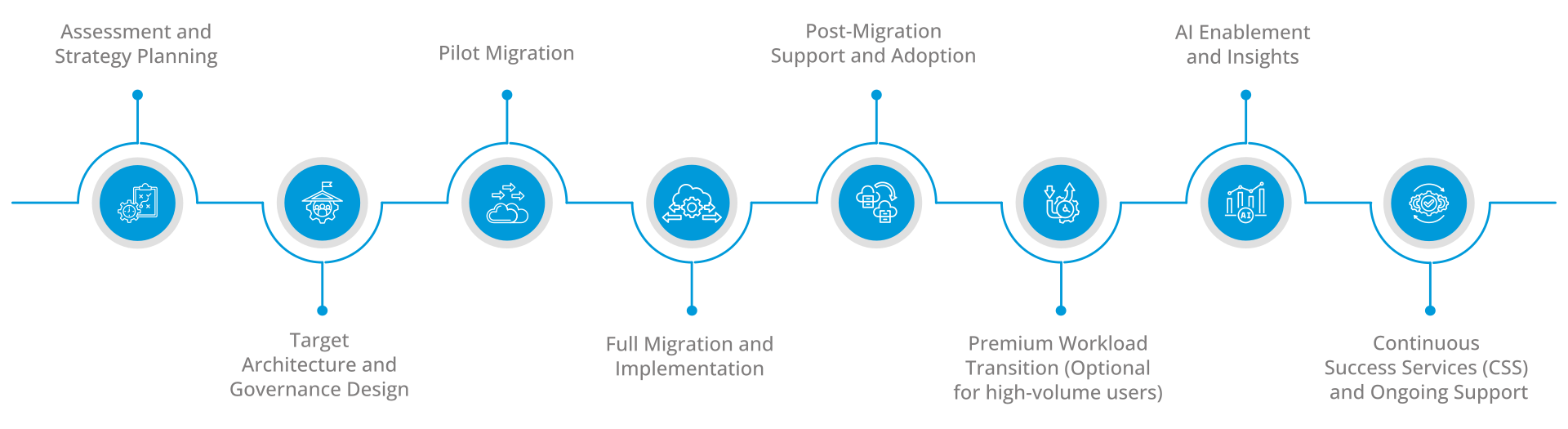
Looking for specialized support on Power BI Premium to Microsoft Fabric Migration?
As Power BI Premium (P SKUs) retires, our experts ensure a smooth and secure migration to Microsoft Fabric in just 6-8 weeks, enabling you to harness data, governance, and AI efficiently.
Learn MoreModernizing Power BI for AI-Driven Analytics
A leading U.S. fuel and convenience retailer modernized its Power BI environment by migrating to Microsoft Fabric. By implementing a governed Medallion Lakehouse on OneLake and integrating PDI FP data, the organization unified store, product, and customer data into a trusted analytics foundation. Existing Power BI reports were repointed instead of rebuilt, accelerating time to value while enabling AI-ready analytics.
Read the full story60% Faster Access to Insights
Accelerated reporting with near real-time visibility into promotions, sales, and item performance.
40% Reduction in Manual Effort
Unified disparate data sources into a governed platform, eliminating manual consolidation and data silos.
30% Improvement in Data Reliability
Improved data accuracy and consistency through a centralized, governed foundation built for enterprise analytics and AI.
Why LevelShift
- Microsoft Specialized Partner for Analytics, Data Warehouse Migration, and Low-Code Solutions
- Library of 100+ prebuilt industry dashboards across PMO, hospitality, finance, retail, healthcare, insurance, and manufacturing
- Accelerators for SSRS-to-Power BI migration, SSIS metadata migration, and Tableau-to-Power BI metadata conversion
- Copilot enablement built on governed semantic models for accurate, natural language insights





FAQs
- Centralized analytics storage with OneLake for all organizational data
- Faster queries via Direct Lake Mode without duplicating datasets
- Improved dataflows with Dataflow Gen2 for ETL automation and accessibility
- AI-assisted insights and report generation through Copilot
- Strong governance and compliance via Purview and our Data Compliance Services
Ready to Transform Your Power BI Experience?
Moving to Microsoft Fabric is more than a compliance requirement — it's a path to modern, AI-ready analytics and governed decision intelligence.
Migrate from Power BI to Fabric