Headless 360 Services
Your Salesforce platform, now built to run beyond the browser.
Headless 360 - The Shift, In Plain Terms
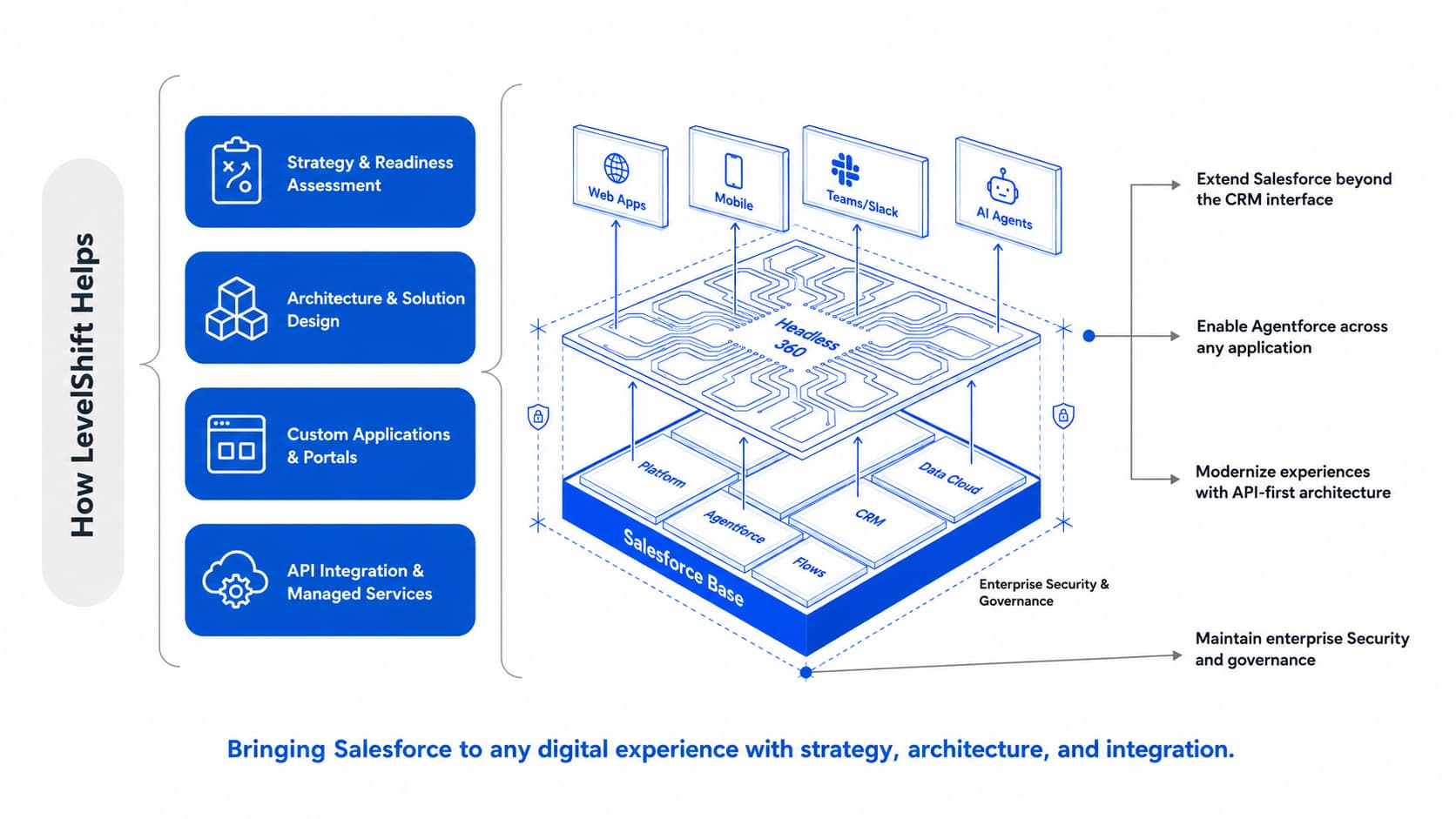
Headless 360 makes the browser optional. It's Salesforce's approach to exposing its data, workflows, business logic, and permissions beyond the traditional Lightning UI, making them directly accessible through APIs, MCP tools, and CLI commands.
What that unlocks:
- AI agents can call Salesforce directly and inherit the same governance and permissions your teams already built — not a workaround, the real thing.
- Development isn't limited to Salesforce's own UI tooling. Teams can build front-ends in whatever framework they already use and still run on Salesforce's data and logic underneath.
- A new experience layer means Salesforce-powered interactions can show up in Slack, voice, WhatsApp, or a custom app — not just inside the CRM.
Want the deep dive on what's actually new?
Read our guide: Salesforce Headless 360 Explained.
Talk to our Experts
Why This Changes the Conversation
If you own the platform
CIOs, CTOs, enterprise architects: Headless 360 is the cleanest path yet to extending Salesforce across the enterprise without rebuilding logic you already have. The risk isn't the architecture itself, it's building it without governance designed in from day one.
If you own the agentic strategy
AI and innovation leaders: your agents don't need more information, they need trusted, governed access to act. Headless 360 gives agents a direct line into Salesforce's data and logic instead of a workaround built around the UI. What matters now is which actions you expose, and how you keep them safe.
Digital, CX, and partner teams see real upside here too
Headless 360 gives teams a stronger foundation to build connected experiences, automate workflows, and extend Salesforce data and logic beyond the UI. It shifts the focus from what the platform exposes to what teams can build, connect, and scale.
How We Help You Get There
Headless 360 Strategy & Readiness
Find where headless creates real business value for you specifically, then build the roadmap to get there: architecture assessment, use-case identification, gap analysis.
Best for
Architecture & Solution Design
Design the API-first, secure, governed architecture that separates what Salesforce does from how your users experience it — security, data, and performance built in from the start.
Best for
Custom Digital Experiences
Build customer, partner, and employee-facing portals, web, and mobile applications — powered by Salesforce underneath, built on your terms on top.
Best for
Agentforce & Data 360 Enablement
Bring trusted data and governed AI actions into the workflows where they matter: agent-to-system integrations, AI governance, Data 360 integration.
Best for
API & Integration Engineering
Connect Salesforce to the rest of your stack — MuleSoft, third-party systems, event-driven integrations — without duplicating logic you already own.
Best for
Managed Services & Optimization
Keep the whole thing secure, monitored, and improving after go-live: performance optimization, API monitoring, architecture evolution.
Best for
Ready to unlock Salesforce Headless 360?
Talk to our experts about building an agentic architecture around the Salesforce capabilities you already have.

Driving Account Management Efficiency with Agentforce
For a leading U.S. tax and advisory firm serving more than 1,100 small and medium-sized businesses, manual account management and fragmented data slowed follow-ups and created revenue leakage. We implemented Salesforce Agentforce to unify account information, identify next-best actions, and automate customer communications.
See How We Did It45% Increase in Account Management Efficiency
AI-powered account management streamlined workflows, reduced manual effort, and improved client engagement.
75% Faster Response Times
Automated account analysis and proactive follow-ups helped teams respond to client needs faster.
15% More Efficient Data Collection
Agentforce unified data across opportunities, CPQ quotes, orders, and invoices, giving teams more accurate account insights.
Customer Testimonials
“LevelShift's expertise in Agentforce implementation was instrumental in our successful deployment. Their team worked closely with us to design and launch AI agents that have significantly improved our customer service operations.”
EVP of Customer Experience at Ever.Ag
Why LevelShift
We've spent more than a decade being the partner Salesforce customers call when the platform moves — not after the dust settles, while it's still moving.

Affordable
A Pay-As-You-Use model lets customers subscribe for a period and pay only for the services they use.

Flexible
Unlike any traditional service model like fixed-bid or time & material, our model is red tape-free and easy to assess.

Scalable
On Demand Services provide flexibility in scaling resources up or down depending on business dynamics.

Agile
On Demand Services save time by eliminating the need to create SOWs, ensuring quick kickoff and early product delivery.

Available
No lengthy contracts or cumbersome paperwork - our 24/7 On Demand Services include knowledge transfer for smooth customer support.

Forrester Q4 2025
Recognized in the independent Salesforce Consulting Services Landscape for Agentforce, Data Cloud & Field Service.
Headless 360 isn't a new discipline we're learning alongside you. API-first architecture, integration engineering, and Agentforce enablement are already core to how we build. Salesforce just gave our day-to-day a name and a bigger surface area.