An AI agent that recommends a next step is useful. An agent that updates a customer record, initiates a transaction, or changes an ERP entry creates a different level of responsibility.
Enterprises need to know not just whether its answer is accurate, but whether its actions are authorized, traceable, and financially sustainable. This shift from model risk to execution risk is at the heart of Boomi’s Agent Control Plane.erp+1
Boomi positions the Agent Control Plane as AI-native infrastructure that connects agents to enterprise systems, grounds them in business context, and governs their interactions across agents, models, and tools. Its purpose is to help organizations move from isolated AI experiments to controlled production deployments without surrendering architectural flexibility.
The central issue is control: giving agents enough access to create business value while enforcing clear boundaries around what they can do, which data they can use, and how much they can spend.
Why Enterprise AI Needs More Than a Better Model
Connecting AI to business operations introduces risks that model selection cannot resolve. A capable model can still reach the wrong system, operate with excessive permissions, burn tokens in an uncontrolled loop, or act on incomplete business context. Boomi groups these challenges into three areas:
- Operations: Fragmented agents, siloed data, and brittle connections make it hard to scale workflows across enterprise applications.
- Governance: Limited visibility into agent activity creates uncertainty about data access, security, accountability, and regional sovereignty.
- Cost: Unpredictable model usage and token consumption can turn promising AI initiatives into unmanageable operating expenses.
The gap is already measurable. A Forrester Consulting study commissioned by Boomi found that 86% of surveyed leaders had moved beyond AI pilots, while only 34% trusted the actions their agents took. Organizations that deployed prematurely reported an average of $2.1 million in additional costs. That is a deployment problem, not a model-performance problem.
Restricting connectivity reduces exposure but also limits what agents can accomplish. The alternative is governed connectivity: access to business systems, with identity, permissions, usage limits, and approval requirements enforced.
What Is Boomi Agent Control Plane?
Boomi Agent Control Plane is a unified AI infrastructure layer for agent connectivity, observability, governance, deployment, and lifecycle management. It covers native and third-party agents, so oversight is not limited to agents built within one vendor ecosystem.
Where the Agent Control Plane differs from the wider iPaaS market is architecture. Many platforms add agent capabilities as a separate layer on top of existing tooling. Boomi delivers agent governance on the same platform that already runs enterprise integration and API management, so agent policies sit alongside the integrations agents depend on rather than in a parallel toolset.

It answers three connected questions:
- Can the agent reach the systems and tools it needs?
- Does it have trusted business context for its decisions?
- Can the organization observe, constrain, and audit its actions?
The three depend on each other. Connectivity without governance raises execution risk, governance without connectivity limits usefulness, and both weaken when agents lack accurate business context. Boomi’s approach combines its integration, data, and AI capabilities to address all three together.
How does Boomi Agent Control Plane answer the three questions?
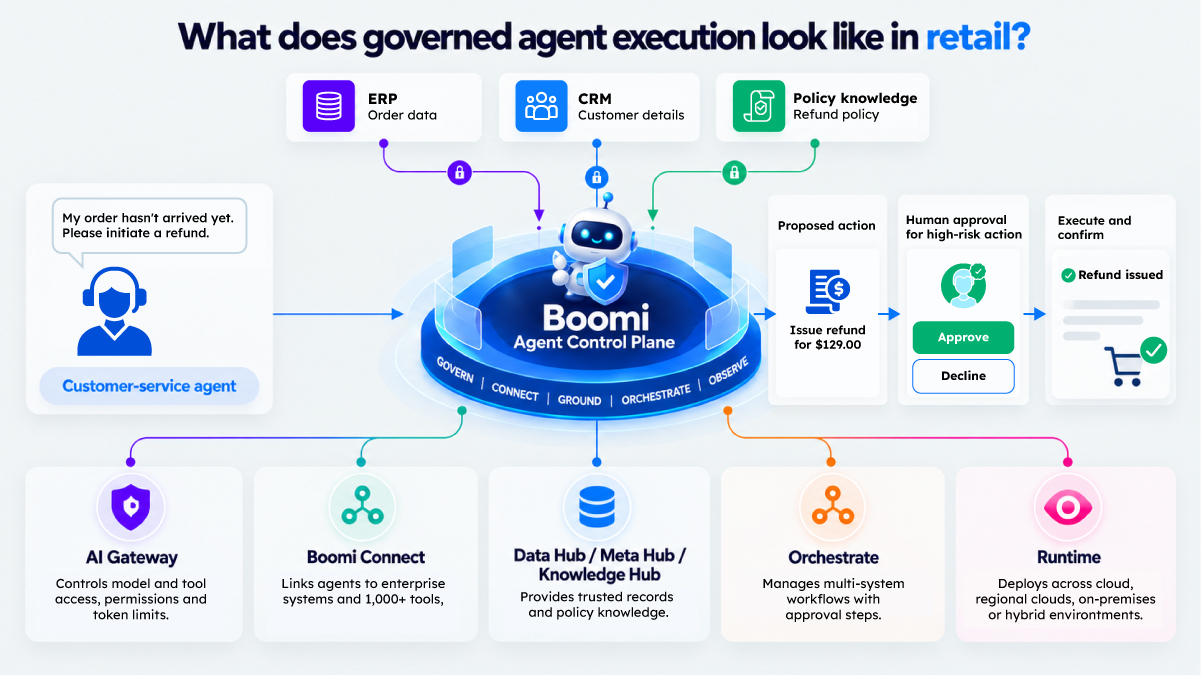
Each question maps to a layer of the platform: reach through Boomi Connect, context through the Data, Meta, and Knowledge Hubs, and control through the AI Gateway, observability, and Boomi Runtime.
Can agents reach the systems they need? Boomi Connect
Boomi Connect exposes enterprise capabilities through Model Context Protocol (MCP) tools. Boomi lists more than 1,000 governed MCP tools out of the box, so agents can work with CRM, ERP, and other business applications without a custom connection for every use case. Managed authentication and OAuth pass-through preserve individual user permissions, which makes identity part of the connection rather than an afterthought.
Connecting an agent to an application does not mean granting unrestricted access. The objective is to expose only the business capabilities the agent needs, under the right permissions.
Do agents have trusted business context? Data Hub, Meta Hub, and Knowledge Hub
Permission to act does not guarantee a sound decision. Boomi describes a governed semantic layer that brings together structured data, unstructured content, and metadata:
- Boomi Data Hub supplies trusted records and business context.
- Boomi Meta Hub provides metadata and data lineage.
- Boomi Knowledge Hub turns fragmented information into an AI-ready knowledge layer.
This strengthens the information an agent reasons over, helping reduce the likelihood of hallucinations and inaccurate responses for greater precision. More accurate retrieval can also reduce token waste from repeated attempts to find the right information.
Can the organization observe, constrain, and audit agent actions? AI Gateway and Boomi Runtime
Control has three parts: enforcement, visibility, and where agents run.
Enforcement: Boomi AI Gateway combines MCP gateway and large language model gateway capabilities into a single enforcement point for AI traffic. It applies role-based access, per-agent rate limits, and human approval gates for high-risk transactional actions. This puts governance directly in the execution path: agents can retrieve information within their permissions, but sensitive transactions are subject to additional controls before they proceed.
For example, a procurement agent could check supplier details, compare quotes, and prepare a purchase order, while purchases above a defined threshold require human approval. This connects system access, business context, and execution controls in a single workflow.
Visibility: Observability covers agent discovery, lineage, audit logs, token usage, and anomaly monitoring. Centralized registration and governance controls help detect and manage unauthorized agent activity. The AI Gateway adds usage controls and intelligent model routing to balance cost, performance, and reliability, while real-time monitoring of token consumption and performance helps finance and IT teams understand resource utilization. The result is a shift from a single aggregate AI bill to clear visibility into which workloads consume resources and whether that spending delivers business value.
Deployment: Boomi supports agentic workloads across cloud, hybrid, and on-premises environments, including deployments behind corporate firewalls. Options include public cloud, customer-controlled virtual private clouds, and on-premises infrastructure. This flexibility helps enterprises align deployment architecture with data residency, proprietary information, and regional sovereignty requirements. However, deployment location alone does not guarantee compliance; access policies, model connections, and data-handling controls must also align with each organization’s security and regulatory obligations.
Where does Boomi Agent Control Plane apply?
These are the five use cases that Boomi Agent Control Plane is designed to solve.
| Scenario |
The problem |
How the Boomi Agent Control Plane responds |
How LevelShift can help |
| Agent sprawl |
Agents run across multiple platforms and vendors. IT cannot see whether they behave as intended or what they cost. |
The registry centralizes multi-vendor agents and tools. The AI Gateway restricts each agent to the systems it needs, sets token limits, and requires human approval for higher-risk actions. |
Our experts help inventory agents, configure gateway policies, enforce least-privilege access, and monitor usage and costs. |
| Connecting AI to enterprise systems |
Employees already use Claude, Gemini, and OpenAI tools. No safe route exists to CRM and ERP data. |
Boomi Connect links frontier models to 1,000+ tools, with security and governance built in. |
We have the expertise to build connectors, expose APIs and MCP tools, and configure authentication and authorization controls. |
| Trust in agent decisions |
Skepticism persists because hallucinations trace back to missing business context. |
Data Hub supplies the system of record, Meta Hub the catalog and lineage, and Knowledge Hub an AI-ready layer. Accurate retrieval also cuts token waste from repeated lookups. |
Our data integration experts help integrate trusted data sources, resolve data-quality issues, and configure retrieval pipelines to ground agent responses. |
| Running agents in any environment
|
Sovereignty rules, such as those in the EU, dictate where agents may run.
|
Boomi Runtime deploys agents in the cloud, in regional clouds, on-premises, or hybrid, preserving a chain of custody over agent activity and data. |
Our experts help configure runtime deployments, network connectivity, environment-specific access controls, and data-residency safeguards. |
| One platform to govern AI |
IT teams cannot add headcount or yet another system to manage. |
Boomi Orchestrate composes multi-system agentic workflows in natural language, staged for testing and review. |
We have the expertise to implement cross-system workflows, configure exception handling and human approvals, and establish testing and production monitoring. |
How does governance fit into agentic resilience?
Preventing unauthorized actions is essential, but enterprises also need a plan for service failures and incorrect outcomes that pass through their safeguards. Boomi’s resilience framework separates the responsibility into three layers:
- Infrastructure: Keep workloads available and absorb routine failures.
- Control: Detect anomalous agent activity and stop harmful behavior.
- Response: Diagnose problems and correct their effects.
Boomi identifies Agent Control Plane as the control layer, including anomaly detection and a kill switch for agents that behave incorrectly or incur excessive costs. Response requires additional operational capabilities, because monitoring alone does not repair an affected process or reverse a business outcome.
Who benefits from Boomi Agent Control Plane?
Each executive gets a different answer from the same layer.
- CIOs gain one control point across a multi-vendor agent estate, with a registry and a single enforcement path replacing fragmented tooling.
- CISOs gain agent identity verification, least-privilege access to systems of record, and an audit trail that can reconstruct a decision months later.
- CFOs and FinOps leads gain token metering, budget caps, and model routing as governed policy. Running models on infrastructure the enterprise controls converts variable per-token cost into predictable compute cost.
- Regulated industries gain deployment choice, with agents and small language models running in-region or fully on-premises to meet sovereignty requirements.
From AI Experiments to Accountable Execution
For enterprise leaders, the question is no longer whether AI agents can perform tasks, but whether they can execute business-critical workflows securely, reliably, and at scale. The real decision is how to scale AI without compromising governance, operational control, or business accountability. Boomi Agent Control Plane provides a foundation for governing agent access, enforcing policies, maintaining visibility, and managing execution across enterprise systems.
LevelShift helps enterprises turn AI strategy into governed execution with Boomi Agent Control Plane. We help leadership prioritize high-value workflows, define risk and access boundaries, establish oversight mechanisms, and align implementation with measurable business outcomes.
Turn agentic AI into business value with LevelShift. Identify the right use cases, establish governance across your AI ecosystem, and scale deployments with clear performance and ROI targets.
FAQs
How does Boomi Agent Control Plane use MCP to connect AI agents to enterprise applications?
Boomi’s MCP capabilities enable AI agents to discover and interact with approved tools and enterprise services. This allows agents to access business applications through governed connections rather than requiring unrestricted access to underlying systems.
How does Boomi Agent Control Plane govern AI agents built on other platforms?
Boomi provides centralized discovery and governance for native and third-party agents, tools, and APIs. Enterprises should validate which external platforms, runtimes, and agent interactions are supported in their intended architecture.
What is the difference between an AI gateway and an AI control plane?
An AI gateway enforces policies on AI traffic, including access permissions and usage limits. An AI control plane provides broader oversight across agent discovery, connectivity, governance, monitoring, and lifecycle management. The gateway can serve as an enforcement component within the wider control plane.
How does Boomi Agent Control Plane compare with Workato AI Control Plane?
Both address AI governance, registry, connectivity, and operational controls. Boomi’s positioning emphasizes enterprise integration, business context, and governed connectivity, while Workato combines AI control capabilities with its automation and orchestration platform. The right choice depends on existing systems, workflow requirements, and governance needs.
How does Boomi Agent Control Plane help reduce AI costs?
Boomi’s AI Gateway supports usage visibility and controls, including token tracking and intelligent model routing. Cost outcomes depend on workload design, model selection, usage policies, and how effectively agents retrieve and reuse business context
Can Boomi Agent Control Plane support hybrid and on-premises environments?
Boomi positions its runtime as deployable across cloud, regional cloud, on-premises, and hybrid environments. Organizations should verify the availability of individual capabilities and deployment configurations against their security, residency, and infrastructure requirements.
How does Boomi Agent Control Plane support human-in-the-loop workflows?
Human-in-the-loop workflows pause agent execution at defined approval checkpoints. Organizations can allow routine tasks to proceed automatically while requiring human review for actions that exceed specified risk thresholds or authorization limits.
What happens when an AI agent fails or produces an unexpected result?
Monitoring, audit trails, exception handling, and escalation paths help teams investigate failures and unexpected behavior. Enterprises should define when workflows retry an operation, stop execution, request human intervention, or initiate recovery procedures based on the business process.
What should enterprises evaluate before choosing an AI control plane?
Evaluate cross-platform agent discovery, identity and access controls, MCP and A2A support, integration coverage, auditability, cost management, deployment flexibility, lifecycle testing, and compatibility with existing infrastructure. Compare documented capabilities against real workflows rather than relying on feature counts alone.