
Enterprise Integration
How Workato Automates the Lead-to-Cash Process with Agentic AI
LevelShift built its Lead-to-Cash solution as a network of Agents on Workato Agent Studio, enabling opportunities to move through quoting, f...
Read More→
October 27, 2026
As enterprises adopt more applications, modernize legacy systems, and automate business processes, connecting technology becomes increasingly complex. The challenge is no longer just moving data between systems. It is choosing an integration platform that can support evolving business requirements, maintain governance, and scale without adding unnecessary operational complexity.
Boomi, MuleSoft, and Workato address these needs through different approaches to integration, API management, and automation. Understanding those differences is essential to choosing the right platform for your enterprise.
This guide compares Boomi, MuleSoft, and Workato across key enterprise requirements to help you understand their differences and determine which platform is the best fit for your organization.
Connecting systems is just the beginning. As businesses add more applications and AI agents, the real challenge is making sure they work together smoothly. Boomi, MuleSoft, and Workato tackle this differently, each with its own approach to integration, automation, and control.
| Decision area | Boomi | MuleSoft | Workato |
| Core strength | Enterprise integration, application connectivity, and data movement | API-led connectivity and integration across complex enterprise environments | Integration and business process automation |
| Integration approach | Visual, low-code integration development with reusable components | API-led architecture with reusable APIs and integration assets | Low-code automation through recipes, connectors, and reusable workflows |
| Platform approach (POV) | Unified integration across applications, data, APIs, B2B, and AI agents. | API-led architecture built around reusable enterprise services and governed agent connectivity. | Business process orchestration with integrated automation and AI control and execution capabilities. |
| Primary use cases | Hybrid and ERP integration, data synchronization, and trading partner exchanges. | Reusable enterprise APIs, cross-system integration, and governed by API programs. | Cross-app workflows, business process automation, and event-driven actions. |
| Deployment model | Boomi-managed runtime clouds or customer-hosted runtimes, including clusters. | CloudHub, customer-managed Runtime Fabric, and on-premises Mule runtimes. | Cloud-hosted recipes with an on-prem agent for access to private systems. |
| Ease of use | Visual low-code processes; advanced mapping still needs integration expertise. | Developer-oriented tools and API design practices; more setup for shared standards. | Visual recipes for IT and business teams; complex workflows still need sound design. |
| Integration complexity | Handles hybrid, legacy, mapping, and B2B requirements in integration processes. | Organizes complex enterprise flows through Mule apps and reusable API layers. | Handles multi-app process logic; custom connectors and APIs cover specialized needs. |
| API management | API management plus federated API Control Plane for APIs across gateways. | API design, lifecycle policies, and reusable assets through API Manager and Exchange. | Exposes recipes as APIs, with gateways, proxies, authentication, traffic management, and policy controls. |
| Data integration | Data mapping, transformation, application sync, and data management options. | Connector-based data flows and transformation across enterprise systems. | Recipe and data-pipeline flows between apps, databases, and data platforms. |
| Workflow automation | Process automation within integration of workflows and cross-system business processes. | Mule flows, with Composer and RPA options for additional task automation. | Multi-step, event-driven recipe automation is central to the platform. |
| B2B/EDI | Native EDI document exchange and trading partner capabilities. | Partner Manager for partner onboarding, message flows, and transaction visibility. | Workato EDI powered by Orderful, with trading partner management, transaction processing, validation, and monitoring. |
| Governance | Central monitoring and deployment controls; federated API governance. | Shared asset catalogue, API standards, lifecycle governance, and policy enforcement. | Project and environment permissions, recipe lifecycle controls, and audit logs. |
| Scalability | Distributed runtimes and clusters support load balancing and high availability. | CloudHub and Runtime Fabric support scaling and resilient deployments. | Cloud job concurrency, retries, and on-prem agent groups support throughput. |
| AI/agent capabilities | Boomi Agent Control Plane provides AI-native infrastructure for governing agents, while Agentstudio builds and deploys them. | Agent Fabric catalogues and governs agents, APIs, and MCP servers across systems. | Control & Execution Plane brings agents under governance, connecting access, tools, and execution to reduce agent sprawl and blind spots. |
| Security | Role-based access, encryption, API policies, and control over runtime placement. | Anypoint access controls, gateway security policies, and cloud or self-hosted runtime choices. | Role-based permissions, encryption, audit logs, and secure connections to private systems. |
Note: Capabilities depend on product editions, licensing, configuration, and the wider technology stack. Validate specific requirements against current vendor documentation.
As AI agents move into production, enterprises need more than system access. They need visibility into agent activity, control over permissions, and reliable execution of business tasks. For example, processing a refund requires validation, approvals, system updates, and exception handling. Effective agent governance must address both what agents can access and what they can execute.
Govern agents across the enterprise
Boomi Agent Control Plane provides centralized visibility, management, and governance for native and third-party agents. It helps enterprises control agent access, monitor performance, and oversee execution. Boomi was also named a Leader in The Forrester Wave for Adaptive Process Orchestration.
Make existing APIs agent-ready
MuleSoft Agent Fabric connects agents, APIs, and MCP servers within a governed environment. Enterprises can reuse existing APIs as agent tools while maintaining visibility and control over system access and actions.
Execute governed business workflows
Workato Agent Studio and Enterprise MCP connect agents to reusable skills, tools, and workflows. Its Control and Execution Platform supports cross-system orchestration with access policies, auditability, and human approvals.
As application environments expand, enterprises need to automate processes, manage integrations, and adapt to change without increasing IT complexity.
Integrate cloud and hybrid environments
Unifies application and data integration, transformation, and workflow automation to manage complex integrations across hybrid environments.
Reuse integrations across teams
Anypoint Platform uses API-led connectivity to create reusable integration assets, reducing duplicate development across applications and business units.
Automate workflows across applications
Uses recipe-based automation to orchestrate business processes across CRM, ERP, finance, and other enterprise systems.
As APIs spread across teams and cloud environments, enterprises face duplicate development, fragmented governance, and limited visibility into dependencies. Each platform addresses a different aspect of API sprawl.
Centralize API visibility
Boomi API Control Plane provides unified discovery, monitoring, and governance across gateways, including MuleSoft, Apigee, Kong, and Azure.
Enable API reuse
Anypoint Exchange provides a shared catalog of reusable APIs and integration assets, while Anypoint Platform manages API design, security, and lifecycle.
Turn workflows into APIs
Workato API Platform exposes automations as APIs and manages existing APIs through its gateway, with Edge Gateway supporting private-network connectivity.
Disconnected CRM, ERP, and cloud systems often create inconsistent data that affects operations, reporting, and AI readiness. Each platform approaches data connectivity and consistency differently.
Maintain trusted master data
Boomi Data Hub creates trusted master records and reduces duplication, while Boomi Data Integration supports data transformation and synchronization.
Connect and share enterprise data
Anypoint Platform connects data sources, while DataWeave transforms information across formats for sharing through reusable APIs.
Automate data pipelines
Workato Data Orchestration automates data extraction, transformation, and synchronization across applications, databases, and warehouses, with pipeline monitoring and error tracking.
EDI involves more than exchanging documents. Enterprises need reliable partner onboarding, transaction tracking, acknowledgements, and error resolution to prevent disruptions to fulfilment and billing.
Manage B2B/EDI within enterprise integrations
Boomi combines trading-partner management, document exchange, acknowledgements, and integration flows for end-to-end transaction visibility.
Manage partner transactions
MuleSoft Partner Manager supports partner onboarding, B2B transaction management, and activity monitoring within the broader integration environment.
Connect EDI to business workflows
Through Orderful, Workato connects partner transactions to downstream processes such as fulfilment, billing, and operations.
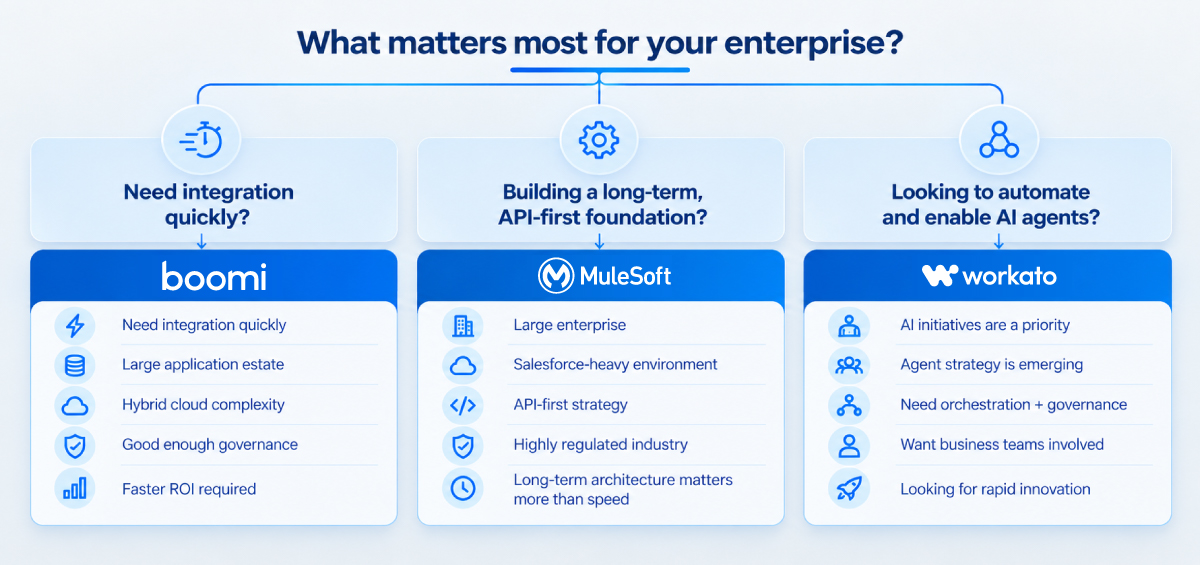
The strongest evaluations look beyond today’s needs. As integration volumes grow, automation expands, and AI agents enter business workflows, a platform that works today may become harder or costlier to manage tomorrow. These challenges rarely surface in a product demo.
The value of a platform depends on what you build with it. With expertise across Boomi, MuleSoft, and Workato, LevelShift helps enterprises make informed platform decisions and build architectures for long-term growth.
LevelShift Boomi360 services span application integration, API and data management, workflow automation, agent management, and ongoing support. Through Workato360, we help orchestrate business processes, introduce intelligent automation, and deploy AI agents with the right controls in place.
The impact? Fewer manual handoffs, reduced integration complexity, stronger governance, and the flexibility to introduce new business and AI use cases without starting from scratch. A shortlist narrows your options. The right partner makes your investment count. Talk to our experts to find the right approach for your enterprise.
Yes. Enterprises can use more than one integration platform to support different business needs. For example, MuleSoft may manage reusable enterprise APIs, Boomi may connect legacy and cloud systems, and Workato may automate workflows across business applications. The key is to establish clear ownership, security standards, and monitoring practices to avoid duplicate integrations and unnecessary complexity.
Not necessarily. Existing integrations and APIs can provide AI agents with access to enterprise systems and business processes. Boomi Agent Control Plane, MuleSoft Agent Fabric, and Workato’s Control and Execution Platform offer different approaches to agent connectivity, governance, and execution. Before replacing your current platform, assess whether it can support the access controls, monitoring, and workflow requirements of your AI initiatives.
Subscription fees are only part of the cost. Enterprises should also account for API and transaction volumes, additional connectors, runtime requirements, implementation, maintenance, and support. As automation and AI adoption expand, consumption-based charges may also increase. A three-year cost assessment based on actual workloads offers a clearer picture than comparing starting prices alone.
Implementation time depends on the number of applications, integration complexity, data quality, security requirements, and existing infrastructure. A straightforward workflow connecting two cloud applications may take considerably less time than a large-scale ERP integration involving legacy systems and multiple business units. Starting with a clearly defined use case can help teams validate the platform before expanding deployment.
All three platforms offer visual development capabilities, although their approaches differ. Workato’s recipe-based automation supports collaboration between IT and business teams, while Boomi provides low-code tools for integration development. MuleSoft emphasizes reusable APIs and shared integration assets. Regardless of the platform, IT oversight remains important for security, data access, testing, and production deployment.
A proof of concept should reflect your actual enterprise environment rather than rely entirely on a vendor demonstration. Test a business-critical workflow involving your existing applications, data, security requirements, and expected transaction volumes. Evaluate how easily teams can build integrations, reuse existing assets, monitor failures, apply governance controls, and manage ongoing costs. This will reveal practical limitations that may not be apparent in a feature of comparison.
Choosing an iPaaS goes beyond features and connectors. LevelShift evaluates your integration estate, architecture, governance, costs, and AI roadmap to help identify the right-fit platform strategy across Boomi, MuleSoft, and Workato.

Sheela Philomena Clement is a Senior Content Writer in the Enterprise Integration practice at LevelShift, specializing in integration, automation, and connected enterprise strategies. She creates thought leadership content that helps organizations simplify complex integration challenges, connect applications and data, and drive greater agility, efficiency, and business value through modern integration solutions.

Boomi Companion brings agentic engineering to the Boomi platform, enabling teams...

Boomi Companion brings agentic engineering to the Boomi platform, enabling teams...

Explore how Boomi AI Agents accelerate agentic transformation by saving time thr...
How Workato Automates the Lead-to-Cash Process with Agentic AI
LevelShift built its Lead-to-Cash solution as a network of Agents on Workato Agent Studio, enabling opportunities to move through quoting, f...

Building Agentic AI with Workato: The Integration Challenges Enterprises Must Address First
AI agents fail in production not because the model is weak, but because the integration layer beneath was never built to enable save operati...

Beyond SFTP: Why Enterprises Are Moving to Boomi Managed File Transfer
Enterprises are moving beyond traditional SFTP because secure file transfer now requires more than scripts and servers. Boomi Managed File T...