
CRM Solutions
What Agentic AI Means for the Future of CRM
A sales manager begins Monday morning with dozens of emails, forecast requests, overdue opportunities, and customer conversations awaiting a...
Read More→
May 30, 2024

As your business grows, your ERP system needs to keep pace. While Dynamics AX is a trusted solution for many, it might not offer the cutting-edge features and functionalities required to thrive in today’s competitive market. Dynamics 365 Finance and Operations (D365 F&O) emerges as a powerful alternative, designed to address the challenges of modern businesses. This is especially relevant as organisations increasingly adopt cloud ERP platforms to improve scalability, security, compliance, and AI-driven decision-making.
Here are FAQs on Dynamics AX to Dynamics 365 Finance and Operations that provide a comprehensive overview of the migration process. If you are ready to begin planning your journey, read our detailed guide on how to migrate from Dynamics AX to Dynamics 365 in 5 simple steps for a clear project roadmap. They answer essential questions to help you make an informed decision about your organization’s future. This guide is also useful for IT leaders comparing Dynamics 365 Finance vs Dynamics AX for cost, licensing, upgrade complexity, and long-term ROI.
AX and F&O are built on the same framework and serve numerous additional purposes as ERP solutions. It has many new capabilities built on AX for complex manufacturing and warehousing. AX has become outdated and no longer supports new implementation. Dynamics 365 Finance and Operations is the current ideal choice for organizations. Microsoft’s product strategy and innovation roadmap is now centred around Dynamics 365 Finance and Supply Chain Management, with continuous feature releases delivered through cloud updates.
F&O supports cloud and on-premise deployments, a massive bonus for companies regarding the transition process. However, most enterprises now prefer cloud deployment because it supports continuous updates, built-in disaster recovery, and tighter integration with Azure security services.
Cost depends on numerous factors for both Dynamics AX and D365 Finance and Operations. Dynamics AX needs infrastructure costs for servers, whereas Dynamics 365 F&O does not. As a result, Dynamics AX users need to spend an average of $25000 per server, whether for in-house servers or hosted on 3rd party servers. In addition to server costs, organisations typically face ongoing expenses related to SQL Server licensing, storage expansion, backup infrastructure, and specialised IT resources required for patching and performance tuning.
Dynamics 365 Finance and Operations users have their ERP hosted on the Azure cloud, eliminating server costs. Cloud hosting also reduces the need for costly refresh cycles every three to five years, which is common in on-prem ERP environments.
Migration costs for Dynamics AX to Dynamics 365 Finance and Operations can vary depending on several factors, including the complexity of your current AX setup, the amount of data to be migrated, and the chosen deployment option (cloud, on-premise, or hybrid). Generally, licensing costs for D365 F&O follow a subscription-based model, eliminating the need for upfront server infrastructure investments required by Dynamics AX. Many organisations also see cost improvements through reduced downtime, simplified upgrade cycles, and better automation across finance and supply chain processes.
| F&O Full users’ license | $210 per month per user |

Licensing for Dynamics AX and Dynamics 365 Finance and Operations differs significantly. Dynamics AX has a perpetual licensing of four types: Enterprise, Functional, Task, and Self-Service. D365 Finance and Operations follows a monthly or annual licensing model and has four types: Full, Operations Activity, Team Member, and Device. This shift from perpetual to subscription licensing can impact budgeting and cost forecasting for your organization. Subscription licensing also makes it easier to scale users up or down based on seasonal business demand, acquisitions, or operational expansion.
Absolutely. Dynamics AX reporting is known for its complexity and slow database performance, hindering real-time insights. Dynamics 365 Finance and Operations is built with superior reporting functionalities. This improved visibility is a game-changer for high-volume industries; see how a commodity trading Dynamics 365 Finance Operations implementation transformed data accessibility and reporting accuracy for one of our clients. It offers fast report creation, diverse data retrieval methods, and smooth integration with Power BI for advanced data visualization and analytics. With embedded Power BI capabilities and cloud-scale performance, organisations can reduce report refresh times and improve executive decision-making using near real-time dashboards.

Yes, updating Dynamics 365 Finance and Operations is significantly simpler compared to Dynamics AX. While AX requires manual updates for each machine and SQL server, Dynamics 365 can update the whole environment remotely. AX’s updates are tedious, and companies tend to bypass updating their application for years. Dynamics 365 updates are easier, and organizations can skip up to three updates. This structured update cadence reduces security risk and ensures organisations can adopt new Microsoft capabilities, such as AI features, automation improvements, and compliance enhancements, without large upgrade projects.
Businesses often have their warehouses in remote locations, and accessing it can become difficult without an internet connection. There are non-cloud deployments for F&O. However, users cannot utilize certain features available only in cloud deployments. Cloud-only capabilities often include advanced AI insights, automation tools, and deeper integration with Microsoft services such as Azure AI and Power Platform.
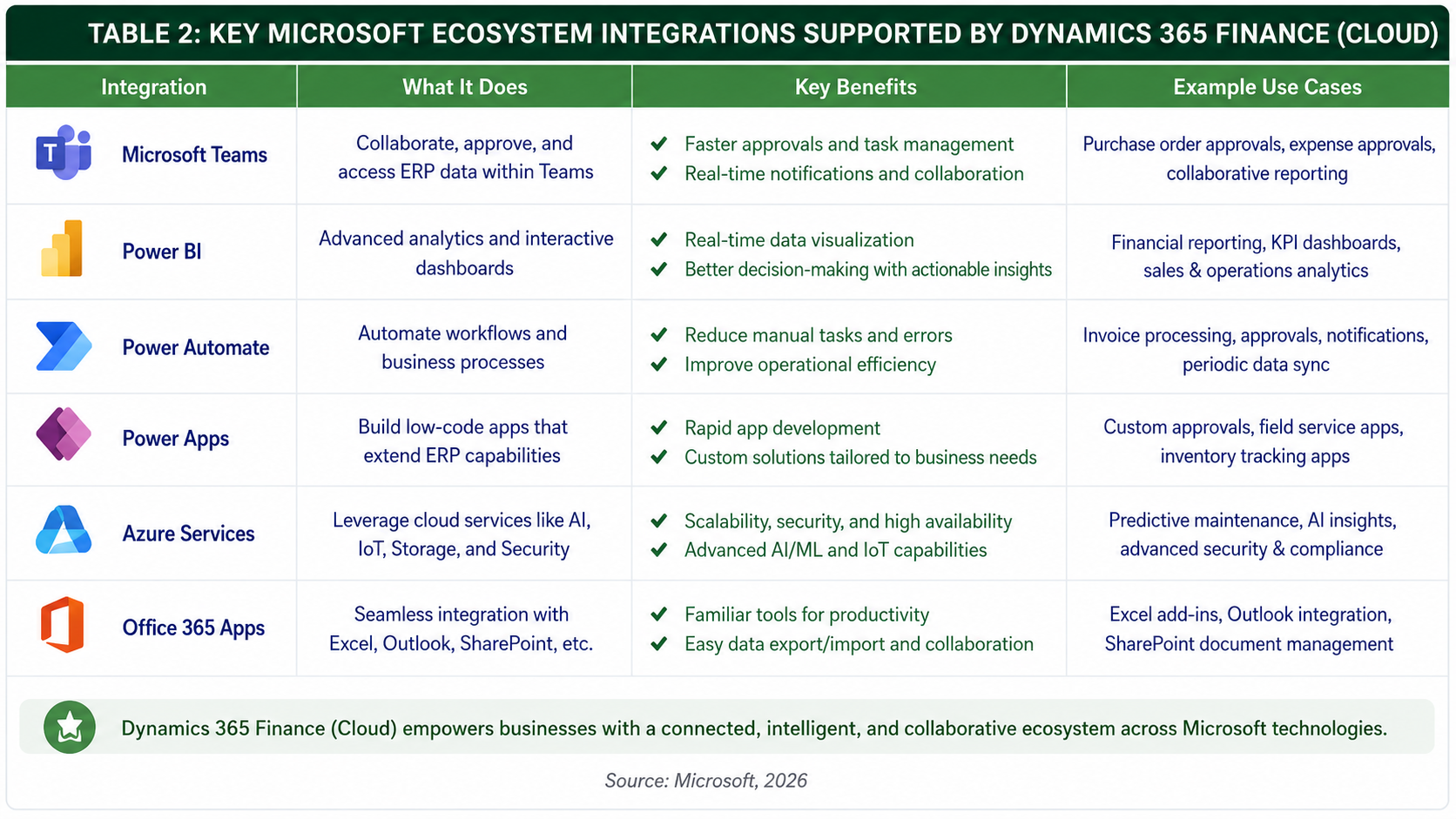
Integration capabilities are another area where Dynamics 365 Finance and Operations shines. D365 F&O seamlessly integrates with a wider range of applications than Dynamics AX. This includes all Office 365 apps, the Power Platform suite, other Dynamics 365 applications, and solutions developed by Microsoft partners. This enables enterprises to build connected workflows between ERP, CRM, HR, procurement, and analytics platforms without relying heavily on custom middleware.
Microsoft no longer supports any versions of Dynamics AX. However, Microsoft partners can extend support for AX 2012 R3. D365 F&O has Microsoft’s complete support and its partners’ support. This is a major advantage because modern ERP environments require frequent regulatory updates, security improvements, and compatibility updates with Microsoft cloud services.
Dynamics AX does not have disaster recovery as a built-in feature, which can cause data loss during times of technical or natural disasters. Dynamics 365 Finance and Operations, hosted on Microsoft Azure, includes disaster recovery functionalities. Azure’s real-time data replication ensures minimal disruption and swift recovery during an outage. This is particularly important for industries where downtime impacts revenue, compliance, or supply chain continuity.
Note: Microsoft controls the preservation period for backups, and if you require extended backups, you must manually move the data to the Lifecycle Services asset library. Organisations with stricter compliance needs often implement Azure Backup policies or third-party retention solutions to meet regulatory backup requirements.
Dynamics 365 Finance and Operations offers a more robust security posture than Dynamics AX. Using Azure’s advanced security features, D365 F&O safeguards your data through multi-factor authentication and other industry-standard security protocols. This enhanced security minimizes the risk of data breaches and unauthorized access. In addition, Dynamics 365 supports modern identity and access management capabilities, including role-based security, conditional access, and centralised monitoring through Microsoft security services.
Microsoft partners play an integral role during migration to Dynamics 365 applications. Internal teams within organizations can help achieve the same goal. However, they typically take longer to complete and tax the in-house technical resources. This is especially true when projects involve large customisations, multi-entity rollouts, complex integrations, and high-volume transactional data.
LevelShift is a Microsoft Gold partner with trained professionals who devise perfect solutions for Dynamics 365 implementations and migrations. Our on-demand services help you with the best solutions within a cost-efficient framework. You only pay for the services you use. This flexible support model is ideal for organisations that want predictable cost control while still accessing certified Dynamics 365 expertise.
Talk to our experts to learn about migration to Dynamics 365 Finance and Operations. We can help you evaluate upgrade readiness, estimate migration effort, and build a phased roadmap aligned with your business priorities.

Aishwarya Nagarajan is a Senior Content Writer in the Microsoft Dynamics 365 practice at LevelShift, specializing in ERP and CRM transformation, AI-powered business applications, and customer engagement. She creates thought leadership and solution-focused content that helps organizations modernize operations, improve decision-making, and drive sustainable business growth.

Microsoft is not shutting off Dynamics GP tomorrow, and that is precisely the pr...

A successful AI agent pilot can demonstrate clear business value, but expanding ...

A high lead score feels like progress. The dashboard shows that a prospect is en...
What Agentic AI Means for the Future of CRM
A sales manager begins Monday morning with dozens of emails, forecast requests, overdue opportunities, and customer conversations awaiting a...

Dynamics 365 Finance and Operations Automation: Where Businesses Save the Most Time
Finance teams rarely struggle because they lack expertise. More often, they struggle because too much of their day is consumed by routine ad...

From Workflow to Autonomous Flow: Designing AI Agents for Accounts Payable Automation in Dynamics 365 F&O
A significant shift is underway in how finance teams approach accounts payable in Dynamics 365 Finance and Operations, and it goes beyond th...