The decision to move to Boomi was made in the boardroom. The reality lands with the integration team.
Hundreds of processes. DataWeave scripts are embedded everywhere. Custom connectors, API policies, and error handlers built up over the years. All of it needs to be moved accurately to a platform that operates very differently.
This is why most MuleSoft-to-Boomi migrations run over time, over budget — and in some cases, never fully complete.
This is where agentic AI earns its place. Not as a tool that assists, but as an agent that executes end-to-end at scale, without a human in the loop at every step.
The LevelShift’s Agentic AI Boomi Migration Solution, built on AI Agents and available on the Boomi Marketplace, ingests MuleSoft configurations, transforms components, and programmatically builds Boomi processes, giving integration teams a faster, more reliable path to Boomi without the manual effort, the errors, or the months of specialist work.
What Makes MuleSoft to Boomi Migration Difficult?
- DataWeave does not translate directly to Groovy: MuleSoft’s DataWeave language is expressive and deeply embedded in integration logic. Boomi uses Groovy. They are not interchangeable, and every script has to be reinterpreted and rewritten. In a large integration, this alone can take months.
- Connector models vary across platforms: A MuleSoft connector and its Boomi equivalent may look similar but behave differently. Configuration schemas, authentication patterns, and error-handling behaviors all need to be rebuilt, not simply copied.
- Routing logic is platform-specific: MuleSoft’s routing patterns do not map cleanly to Boomi’s process model. Each must be understood and reconstructed in Boomi’s native terms before it can be trusted in production.
- Manual work compounds risk at every step: Each manual step introduces a potential point of failure. A mistranslated mapping or an incorrect routing condition can pass initial testing and only surface in production, where the cost of fixing it is higher.
Introduction LevelShift’s Agentic AI Boomi Migration Solution
The LevelShift’s Agentic AI Boomi Migration Solution built on AI Agents simplifies the transition from MuleSoft to Boomi by automating the migration of integration workflows, script conversions, transformation logic, connector compatibility, and system dependencies.
The Agentic AI Migration in Action: Five Steps from MuleSoft to Boomi
Here is how agentic migration executes MuleSoft to Boomi in five steps, keeping your team in control while eliminating manual effort.
1. Assess: The agent identifies source and target platforms, loads the components to be migrated, and automatically evaluates project scope. Your team sees the full picture before a single component moves.
2. Map: Using AI-assisted templates, the agent maps MuleSoft components, data flows, and APIs to their Boomi equivalents. DataWeave scripts, nested logic, and field mappings are interpreted automatically.
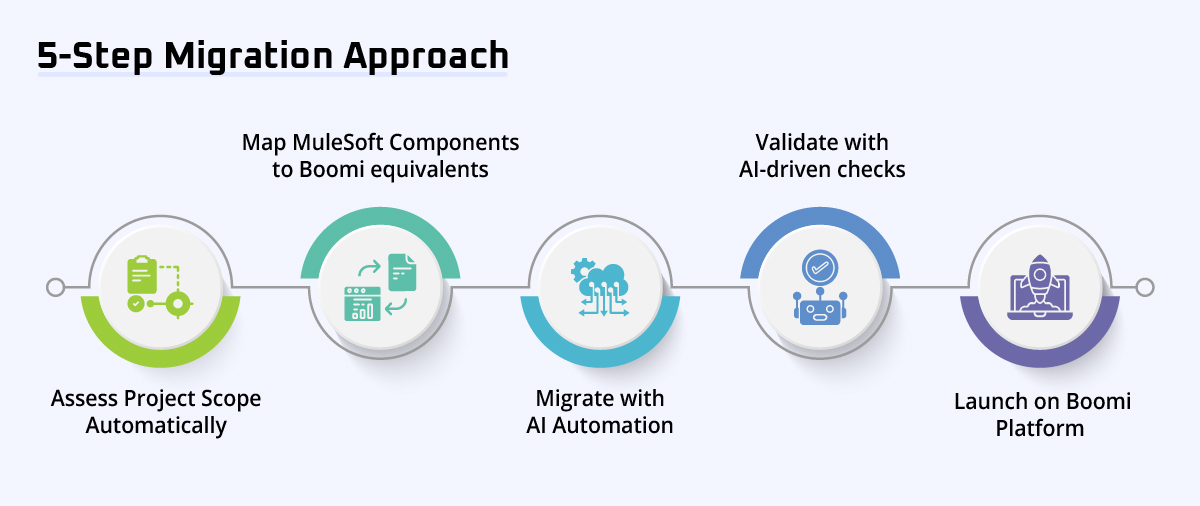
3. Migrate: The agent performs the migration autonomously. APIs, processes, mappings, and error handling are converted into Boomi-native components step by step, with sequencing and dependencies managed throughout.
4. Validate: Automated validation confirms performance, accuracy, and functional parity. AI-driven checks ensure every component has migrated correctly before anything reaches production.
5. Launch on Boomi: All components are live. The agent has eliminated the manual work that typically dominates the final stages of migration, resulting in a fast, error-free go-live.
|
Watch firsthand what happens when Agentic AI takes the wheel of your MuleSoft to Boomi migration strategy.
Find out How
|
Key Features That Make Migration Zero Friction
- Automated code conversion – Transforms MuleSoft flows, connectors, and components into Boomi-native equivalents with minimal manual effort, preserving the structure and behaviour of your existing integrations throughout.
- Data mapping and transformation – Preserves complex data transformations, field mappings, and business logic during migration, with built-in validation and testing to confirm accuracy at every step.
- Conditional routing – Migrates decision-making logic that routes execution along different paths based on payload content or conditions, reconstructed precisely in Boomi’s native process model.
- Exception and error handling – Routes execution to a centralised error-handling flow that logs issues, sends alerts, and delivers standardised error responses, mirroring the exception management patterns from your MuleSoft environment.
- Performance optimization – Analysis existing integration patterns and optimises them for Boomi’s architecture, improving throughput and reducing latency rather than simply replicating what existed before.
- Agentic AI script conversion – Converts DataWeave scripts into Groovy, transforms nested logic, generates field mappings, and uses AI-driven prompts to handle complex or edge-case script conversions automatically.
Business Use Cases
| Use case |
Without Agentic Migration |
With the AI Migration Accelerator |
Business Impact |
| Boomi Process Reconstruction & Migration |
MuleSoft flows must be manually redesigned into Boomi processes, leading to inconsistencies and delays. |
AI agent automatically reconstructs MuleSoft flows into Boomi-native processes within AtomSphere. |
35% faster assessment and planning, delivered in weeks not months. |
| Data Transformation & Mapping Conversion |
DataWeave scripts require manual rewriting into Boomi mappings, increasing risk of errors. |
Boomi AI converts DataWeave into Boomi mappings and logic, preserving transformation accuracy. |
60% less manual effort. |
| Environment Setup & Deployment Automation |
Manual setup across Boomi environments (Dev/Test/Prod) causes delays and configuration issues. |
Agentic migration automates deployment into Boomi environments and Atoms with structured workflows. |
30% faster testing with zero configuration errors. |
| Migration Validation & Error Handling Optimization |
Lack of structured validation leads to hidden errors surfacing post go-live. |
Built-in validation, testing, and Boomi-based error handling frameworks ensure accuracy during migration. |
25% lower training and support effort. |
Who Benefits from Agentic MuleSoft to Boomi Migration
Integration Architects
- Easier planning and design with AI-driven migration insights.
- Consistent and scalable migration approach.
Boomi Administrators
- Less manual effort in creating and managing Boomi processes.
- Realize faster setup and smoother migration execution.
Integration Developers
- No need to rewrite integrations from scratch.
- Achieve faster development with automated conversion and validation.
Ready to Move to Agentic MuleSoft to Boomi Migration?
If your migration still relies on manual effort, disconnected tools, and slow timelines, it is time to shift to agentic migration, where AI handles execution while your team stays in control of outcomes. The LevelShift’s Agentic AI Boomi Migration Solution, built on AI Agents, enables a smarter way to migrate.
Next steps: