Organisations that look for an ERP migration from on-premise to cloud opt for the Dynamics 365 applications. With the global ERP market valued at $73 billion in 2025 and cloud deployments now representing 70% of all implementations, the window to modernise has never been more commercially favourable. Dynamics 365 Finance and Operations helps transform financial operations with its optimal solution, suitable for companies of all sizes.
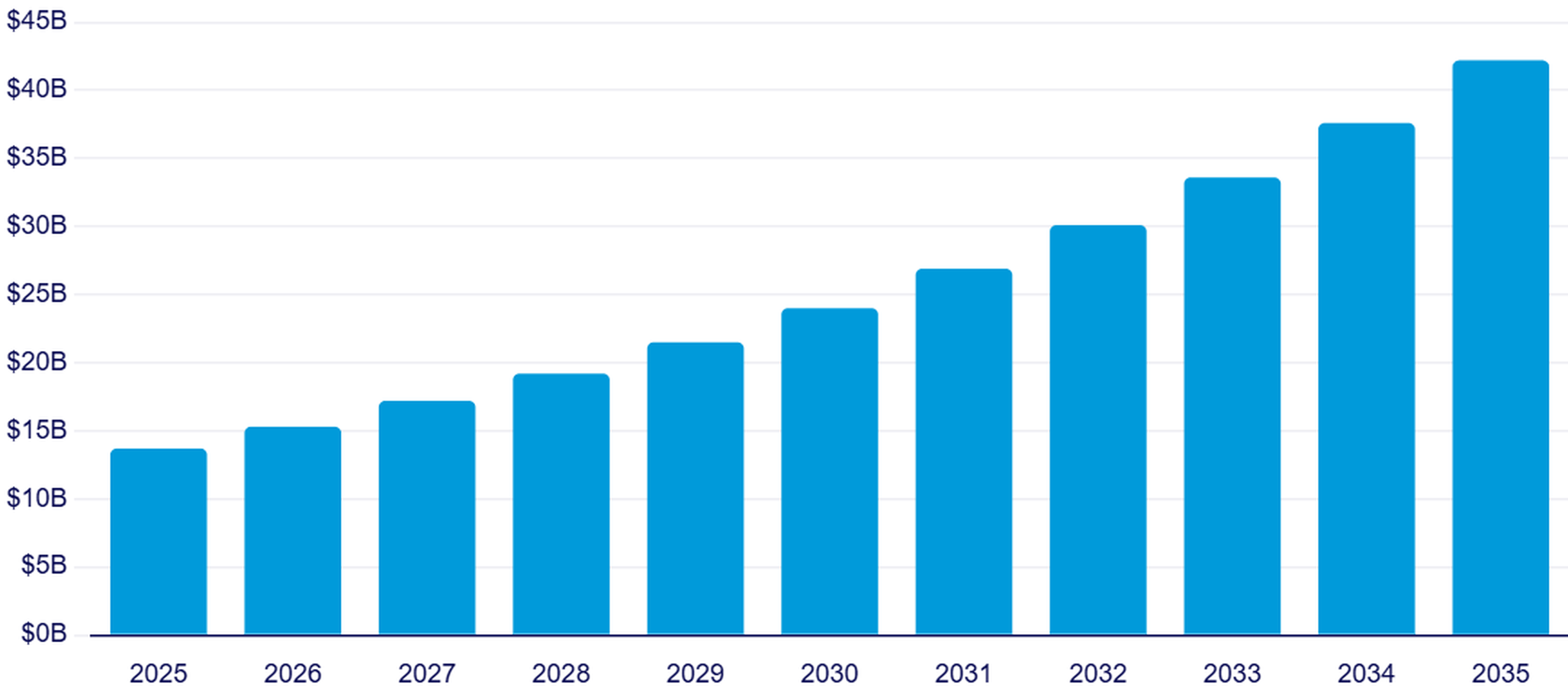
Dynamics 365 Finance and Operations evolved and is now split into two separate solutions: Dynamics 365 Finance and Dynamics 365 Supply Chain Management. These solutions emphasise the upgrades to flexibility and improved capabilities. They are built on the Azure platform that ensures seamless integration with the Microsoft Office toolset and the Power Platform. Its numerous features contribute to advancements in analytics and robotic process automation. In 2025, Microsoft Dynamics holds a 24.66% market share in the ERP category, the highest among all competitors. The Microsoft Dynamics market is projected to grow from $13.7 billion in 2025 to $42.2 billion by 2035, reflecting a CAGR of 11.9%.
Three Reasons Businesses Migrate from Dynamics AX to Dynamics 365 Finance and Operations:
- The total cost of ownership
- Business performance improvement
- Time-to-value acceleration: Migrations are now achievable in as few as 44 days, compared to 116 days on traditional development-led paths.
Dynamics AX Support is Ending
A Dynamics 365 Finance and Supply Chain Management migration allows businesses to enjoy continued product support offerings from Microsoft. Since the clock is ticking on legacy support, it is vital to understand the full scope of your transition options. Read our comprehensive guide on upgrading from Microsoft Dynamics AX to Dynamics 365 to prepare your team for the journey ahead.
Remaining on an unsupported AX version today means operating without security patches, leaving your organisation exposed to regulatory risk and cybersecurity vulnerabilities that modern insurers and auditors increasingly flag.
The following are dates when Microsoft will be dropping support for all versions of Dynamics AX:
| Product |
Mainstream support end date |
Extended support end date |
Status (2026) |
| Dynamics AX 2012 |
10/09/2018 |
10/12/2021 |
End of life |
| Dynamics AX 2012 R2 |
10/09/2018 |
10/12/2021 |
End of life |
| Dynamics AX 2012 R3 |
10/12/2021 |
01/10/2023 |
End of life |
| Dynamics 365 Finance |
— |
— |
Fully supported — continuous updates + Copilot AI |

Benefits of Upgrading from Dynamics AX to Dynamics 365 Finance and Operations
A Forrester Total Economic Impact study commissioned by Microsoft found that organisations migrating from Dynamics AX to Dynamics 365 in the cloud saved over $1.3 million in on-premises infrastructure costs, achieved employee productivity improvements worth more than $2 million by Year 3, and realised licensing consolidation savings of more than 8%, with global multi-deployment organisations reporting savings upward of 20%. The full benefits of making the move include:

1. Significant reduction in the cost of system ownership and licensing
Microsoft offers a 40% transition discount for organisations migrating from AX to cloud-based Dynamics 365
2. Automatic release updates
Two major cloud releases per year, plus monthly platform updates, are included in the subscription at no additional upgrade project cost.
3. Secures critical data with improved security and privacy
4. Better scalability and flexibility
Cloud-native architecture scales with demand without capital expenditure on hardware.
5. Reduces the risks involved in legacy systems
6. Seamless and smooth transition to a cloud-based solution
7. Industry-specific solutions for business needs
8. Robust and in-depth analysis driven by AI
Gartner predicts that by 2027, 62% of ERP application spending will include AI capabilities, up from just 14% in 2024. Dynamics 365 Copilot is already embedded and live across finance, supply chain, and operations workflows.
This is especially critical for data-intensive industries; for instance, see how a commodity trading Dynamics 365 Finance Operations migration enabled real-time global visibility and smarter risk management for one of our clients.
A Microsoft Partner to assist the Dynamics AX to Dynamics 365 F&O Migration
After consulting with Microsoft experts and understanding the technicalities of migrating from AX to F&O, we advise you to consider a third-party Microsoft-certified partner.
A migration supported by internal teams is an option that organizations can assess. However, dedicated resources are required to study the proposed application and its technicalities, which can be very time-consuming. The integration process is at risk if the team discovers any errors until engineers figure out and apply a solution. Internal migration teams also typically lack the domain-specific tooling and prior risk exposure that implementation partners accumulate across multiple projects. Errors discovered late in a self-led migration, particularly around data validation, custom configuration mapping, and integration layer conflicts, can extend timelines by months and significantly inflate cost.
Microsoft implementation partners have years of experience and have seen numerous risks and errors and how to fix them. Hiring a Microsoft migration partner is the best decision for a seamless and trouble-free migration. Tools designed specifically for AX-to-D365 migrations have demonstrated up to 62% faster data migration using configurable templates compared to custom development, reducing both delivery time and implementation risk.
Related: Dynamics AX to Dynamics 365 Finance and Operations – Top ten FAQs
One step closer to your Dynamics AX to F&O migration partner—LevelShift
LevelShift has a team of diverse experts in the Microsoft Dynamics 365 arena. As an AI transformation partner serving 300+ customers globally, and certified as a Great Place to Work for five consecutive years from 2021 to 2025, LevelShift brings structured, industry-centred delivery to every migration engagement. The team brings world-class solutions to their clients and adds customisation according to the business’s unique needs. LevelShift ascribes to an on-demand services model where you can get assistance whenever you want and only pay for what you use. It breaks the traditional subscription model and promotes zero commitment and cost efficiency.
Schedule a meeting with our experts to get more information about the migration to the cloud and the services that LevelShift provides.