Key insights from five essential sessions on agentic AI, autonomous IT, data security, and enterprise innovation
Dreamforce’26 is underway in San Francisco, with AIforce and the broader shift toward agentic AI taking center stage in the Day 1 keynote. Salesforce CEO Marc Benioff was joined by leaders from NVIDIA, Anthropic, and Siemens to discuss the next phase of enterprise AI, including how AI can work with trusted business context and take action across workflows.
The broader AIforce launch also brings Salesforce into Claude through Claudeforce, extending Salesforce data, workflows, and governed actions into Claude.
Session 1: Conversational, Proactive and Ambient Agents: How to Tell Them Apart
The foundation of effective agentic AI lies in understanding how agents think and act. This session introduced a critical framework for evaluating and building agents that solve real business problems.
Understanding Agentic Pattern Indicators
Agentic patterns are evaluated across four key indicators: data autonomy, trigger point, user engagement, and value driver. These indicators help differentiate between three primary agent types:
Conversational Agents
Conversational agents require user input and follow-up details to handle unique requests. They operate on a pull model, where users initiate work through a central interface. The value here is measured in fewer clicks and smarter responses to user inquiries.
Proactive Agents
Proactive agents use CRM and job-specific context to act autonomously based on system events or schedules. They operate on a push model, notifying users when attention or completion is required. The value extends from task automation to proactive issue resolution.
Ambient Agents
Ambient agents continuously observe live or near-real-time data and respond automatically to predictable events. This represents the most advanced agent type, delivering real-time assistance and preemptive task automation.
The takeaway: Understanding whether an agent is conversational, proactive, or ambient helps organizations choose the right approach based on the level of autonomy, user involvement, and business value required.
Session 2: How Salesforce Built Autonomous IT with Agentforce
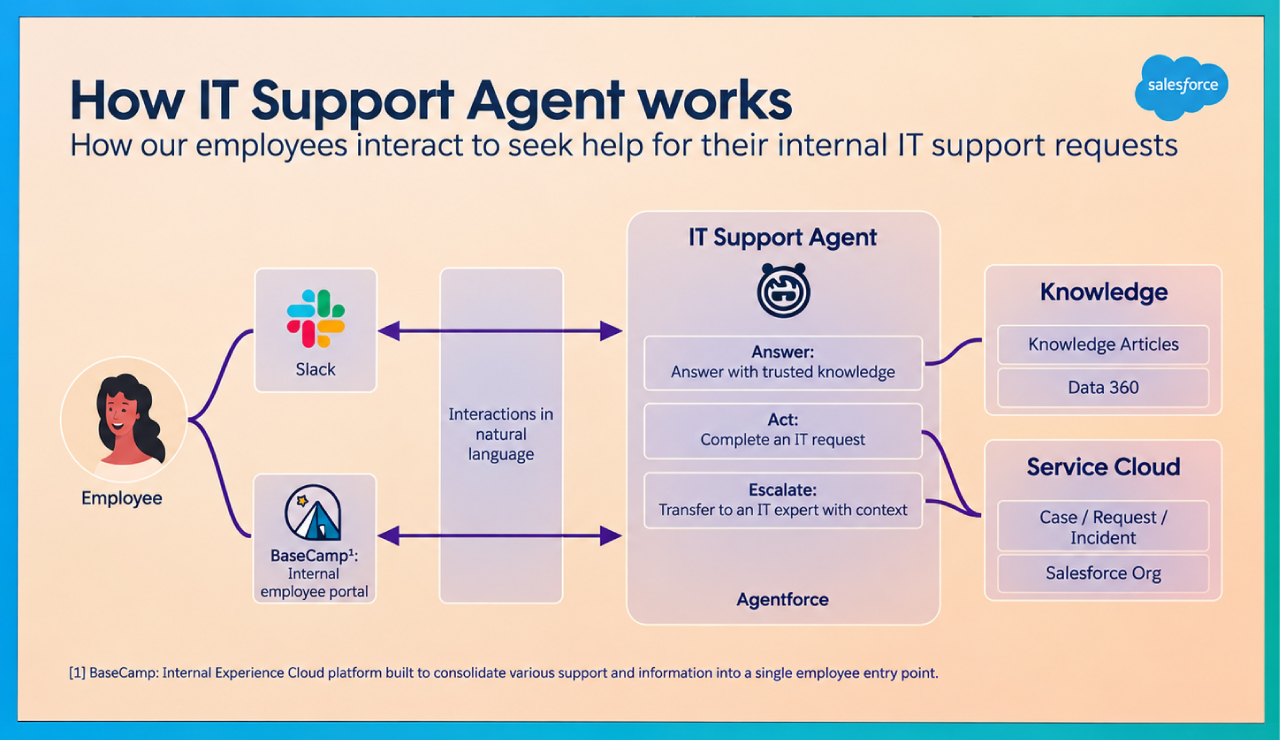
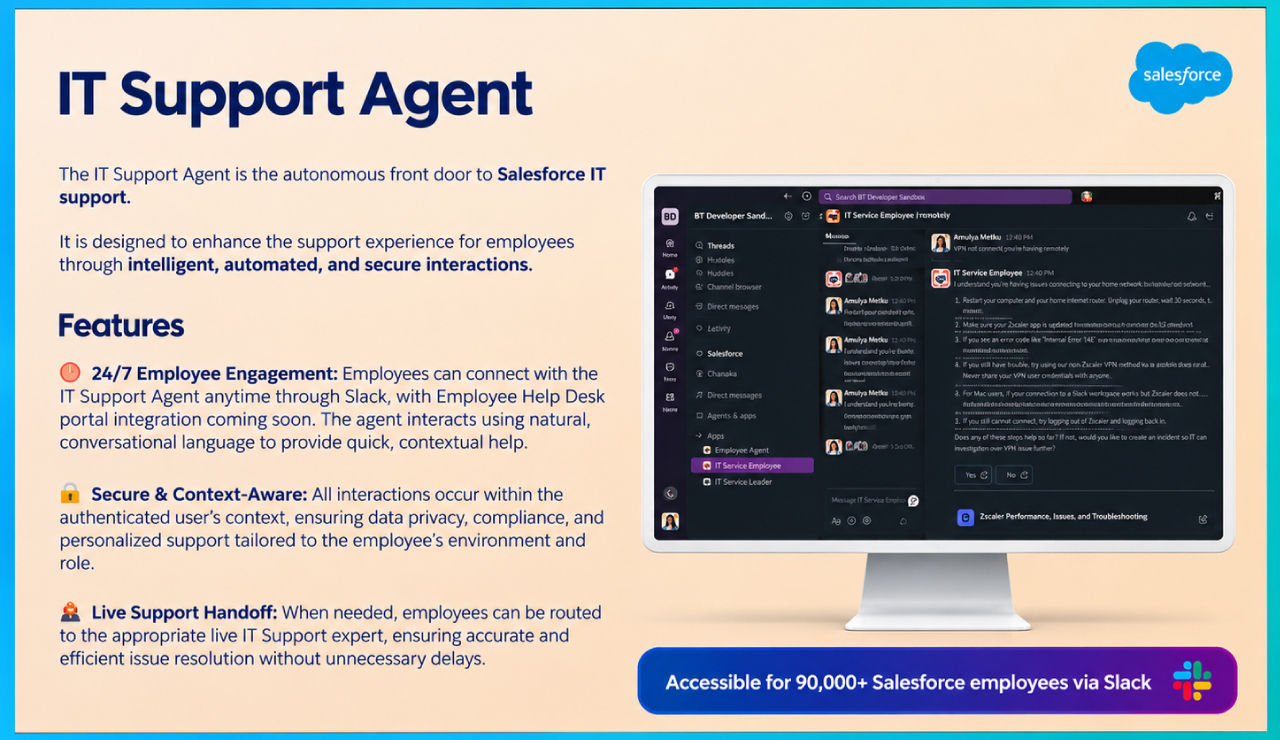
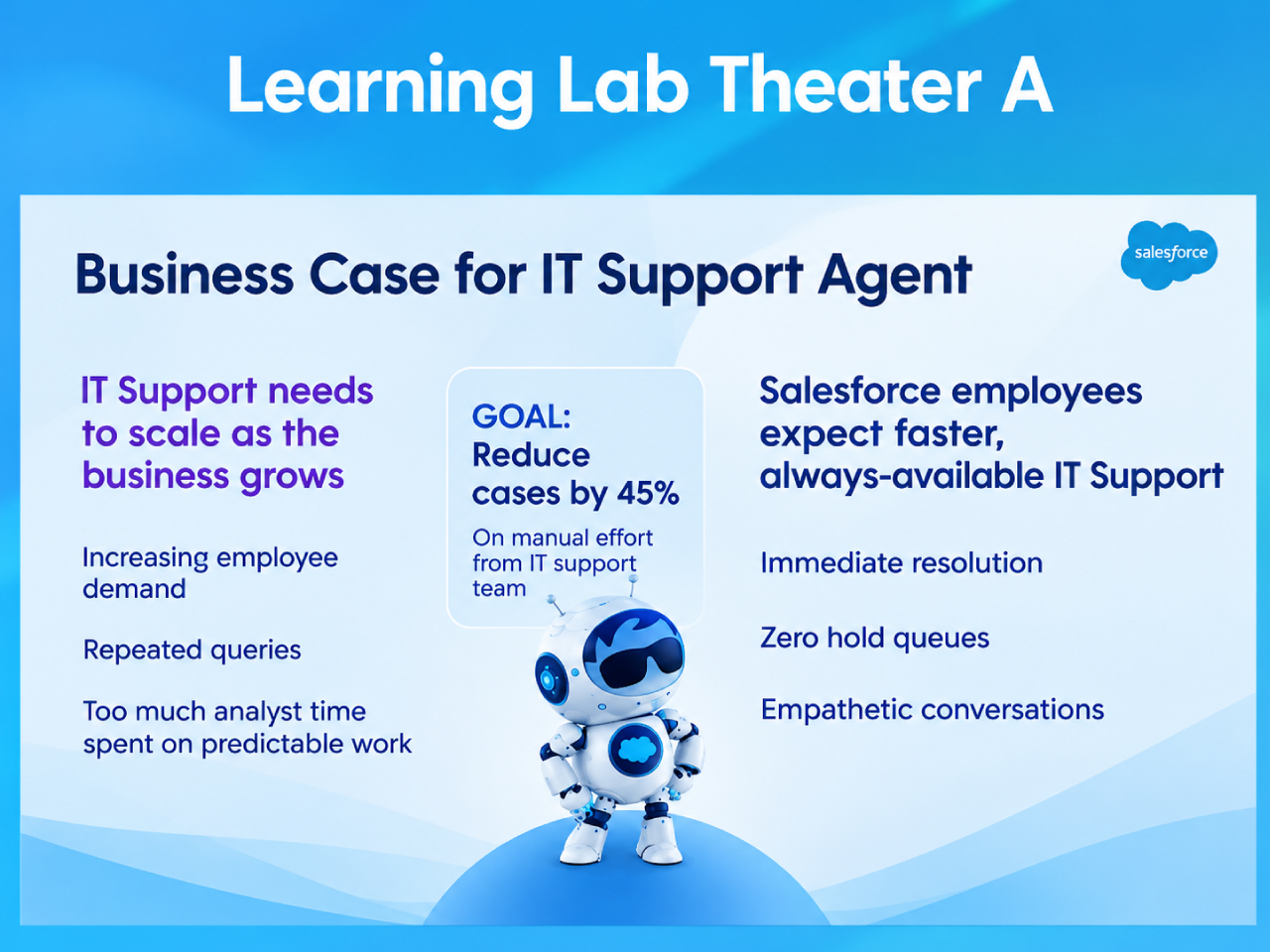
This session showcased how Salesforce is using Agentforce to automate IT support through its IT Support Agent, an autonomous front door for employee IT support.
Employees can interact with the agent through Slack using natural language to get contextual help, complete approved IT requests, or troubleshoot issues. The agent works within the authenticated employee context and uses Knowledge, Data 360, Service Cloud, and Salesforce Org data to retrieve information and take action.
For example, if an employee reports a lost laptop, the agent can identify the relevant service, create a service request, and initiate the required action. When an issue needs human support, it can escalate the request to an IT expert with context.
The takeaway: Autonomous IT works when agents have access to trusted data, clearly defined actions, secure controls, and human escalation paths.

Session 3: Salesforce Data Mask and Data Seed: Safe Sandbox Data for AI Testing
This session focused on how Data Mask and Seed help teams create secure, realistic Sandbox environments for testing and AI development.
With Data Seed, teams can quickly populate Sandboxes with synthetic data instead of manually creating or copying data. They can use starter templates, maintain data relationships such as master-detail records, generate realistic records for objects such as Accounts and Cases, and schedule recurring seeding jobs.
Data Mask helps protect sensitive information in Sandboxes by de-identifying data while maintaining its distribution for reliable testing. Teams can use automated PII detection, choose masking options, target specific records or fields, and schedule masking after a Sandbox refresh.
The takeaway: Teams can use synthetic data for faster testing while masking existing data to protect sensitive information, without compromising the reliability of their Sandbox environments.
Session 4: What are Agentforce Skills? Dreamforce’26 Preview
This session previewed Agentforce Skills, pre-built capabilities that help agents handle specific business tasks without teams having to build every workflow from scratch.
Salesforce showcased examples such as Deal Velocity Analyzer, which identifies pipeline bottlenecks; Champion Finder, which identifies highly engaged contacts; Customer Health Score, which assesses account health; and Objection Handler, which surfaces common deal objections. Other examples included Win/Loss Debrief and Email Open Rate Optimizer.
Skills can be customized and reused across different agents, helping admins and business users automate repeatable work and personalize agents while keeping them within Salesforce’s governance framework.
The takeaway: Agentforce Skills give agents more specialized capabilities that can be adapted to specific business needs.
Session 5: The Agentic Edge – Turning Intelligence Into Impact
The final session focused on what it takes to build an AI-powered enterprise that can operate with trust and control. Synthetic data was highlighted as key to continuously generating trustworthy data and building confidence in AI.
The session also emphasized a gradual approach to autonomy: start with clear rules and guardrails, then increase AI’s freedom as trust grows. With multiple agents working together, an agent orchestrator can manage interactions and ensure they communicate effectively within those guardrails.
AI needs to be embedded, proactive, and supported by human direction. While agents can handle micro-decisions, humans still provide the top-down steering. The right governance tools, along with an abstraction layer that brings together decisions across agents, are essential as AI becomes more deeply integrated into the enterprise.
The takeaway: Building an agentic enterprise requires a measured approach to autonomy, with trusted data, strong governance, agent orchestration, and human oversight working together to scale AI safely and effectively.
Moving Forward: From Dreamforce Insights to Implementation
The first day of Dreamforce’26 highlighted how quickly agentic AI is moving from individual use cases into broader enterprise operations. Across the sessions, a few themes stood out: clear governance, trusted data, defined agent capabilities, and human oversight.
For organizations exploring Agentforce, the next step is turning these ideas into practical use cases. That means identifying where agents can add value, preparing the right data, defining guardrails, and gradually expanding autonomy as trust grows.
At LevelShift, our Salesforce experts help organizations move from Agentforce strategy to implementation, with support across architecture, deployment, integration, and governance.
Want to explore what Agentforce could look like for your organization? Connect with the LevelShift team to discuss your roadmap.