Why Real Time Intelligence is Crucial
For a business leader evaluating real-time analytics, the question is no longer “whether it would reshape the industry or not” but how quickly they can adopt it and deliver the desired value.

Source: Microsoft
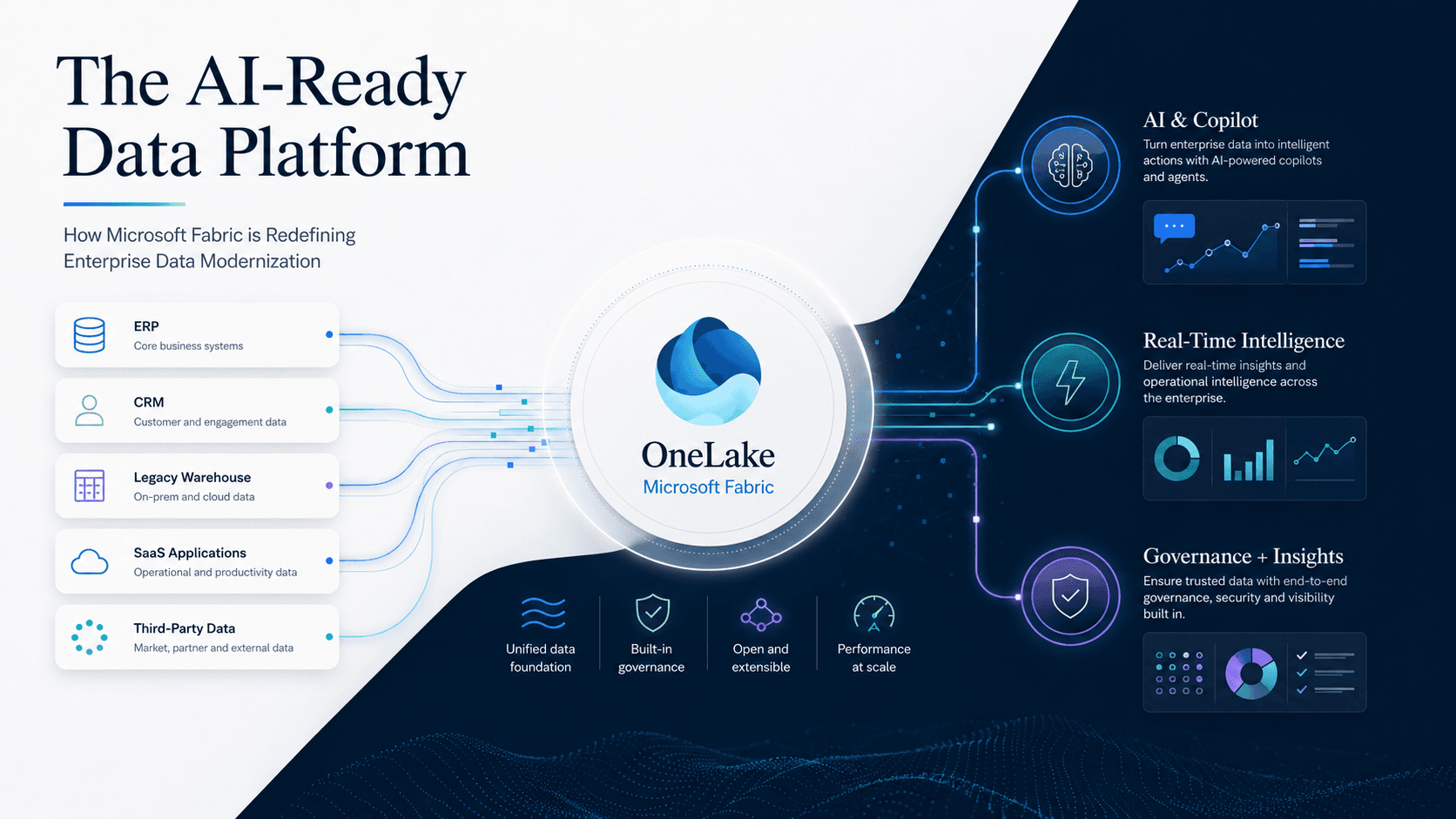
Unlike other players, Fabric delivers ingestion → processing → AI → visualization → governance in a single, SaaS-based, governed environment. Our field experts have observed that this would mean less integration risk, faster time-to-value, and higher adoption across the business—not just in IT.
For Decision-Makers: TL;DR?
| Business Lever |
Advantage With Fabric RTI |
Example ROI Metric |
Downside Without RTI |
| Revenue Acceleration |
Live personalization, dynamic pricing, and real-time offer deployment. |
+21% revenue growth in retail (Fabric case study). |
Lost upsell and conversion opportunities; slower reaction to market demand. |
| Cost Reduction |
Predictive maintenance, process optimization, and resource efficiency. |
-47% unplanned downtime in logistics and manufacturing. |
Higher operational costs from reactive maintenance and inefficiencies. |
| Risk Reduction |
Millisecond-level fraud and threat detection with AI anomaly models. |
-83% fraud-related losses (financial services). |
Increased exposure to fraud, cyberattacks, and compliance penalties. |
| Market Agility |
4.3× faster market responsiveness using unified RTI workflows. |
Measured in faster GTM launches and campaign pivots. |
Competitors seize market share before you can react. |
| Team Productivity |
No-code pipelines, AI-assisted analysis, and cross-department access. |
+38% faster decision cycles in SaaS product teams. |
Bottlenecks caused by reliance on data engineering and delayed insights. |
| Customer Experience |
Real-time service health monitoring and instant issue resolution. |
25% faster incident response in healthcare environments. |
Reduced satisfaction, higher churn, and weaker brand loyalty. |
Finance
Problem: The existing fraud detection systems in AWS/Snowflake environments often require separate ingestion, processing, and alerting layers, which slow down response times and create integration overhead.
Fabric Advantage:
• Eventstreams ingests live transaction data directly into OneLake.
• AI-powered anomaly detection via Copilot triggers holds or mitigations in milliseconds.
• Built-in governance with Microsoft Purview ensures compliance from ingest to action.
Healthcare
Business Impact:
A LevelShift-implemented Fabric RTI solution for a fintech client reduced false positives by 38%, cut fraud resolution from 40 minutes to under 90 seconds, and preserved $3.2M in annual revenue.
Healthcare
Problem: Some of our healthcare clients have raised concerns that many RTI solutions require complex HIPAA compliance overlays. They claim that fragmented systems delay alerts and inflate IT workloads.
Fabric Advantage:
• Direct ingestion from IoT medical devices into a governed OneLake storage system.
• AI models detect anomalies in vital signs in real-time, enabling 25% faster responses to critical events.
• Integration with EHR systems through Microsoft’s secure API ecosystem.
Case Study: A hospital group using Fabric RTI reduced ICU intervention times by 18% while cutting manual alert triage by 40%. (Microsoft)
Supply Chain and Logistics
Problem: During some of our PoCs, we have identified that the AWS + Databricks pipelines often require multiple hops for geospatial, weather, and IoT sensor data, which may slow down real-time optimization.
Fabric Advantage:
• Single data model for GPS, telematics, weather, and ERP feeds.
• Copilot-assisted anomaly detection for route delays, vehicle stress, or inventory discrepancies.
• Predictive maintenance alerts reduced unplanned downtime by 47%.
Case Study: A global logistics provider used Fabric to improve on-time delivery rates by 35%, reducing SLA penalties by $1.1M annually. (Microsoft)
Retail and E-Commerce
Problem: While other platforms have a presence in the e-commerce market, our experts have observed that some of them (particularly Snowflake) have challenges with streaming personalization and still depend on multiple ETL and modeling layers before activation. While this is not a flaw, technically, Fabric still has an edge over certain factors.
Fabric Advantage:
• Real-time personalization triggers based on live user behavior—bypassing batch ETL delays.
• Dynamic pricing models integrate competitor pricing, demand forecasts, and margin rules to optimize pricing strategies.
• Store-level anomaly alerts for loss prevention, managed via no-code workflows.
Business Impact:
A major retail chain reported 21% revenue growth in targeted product categories after implementing Fabric RTI with LevelShift.
Manufacturing
Problem: It is no surprise that disconnected IoT and analytics platforms result in delayed detection of production defects and inefficiencies in the manufacturing sector.
Fabric Advantage:
• Unified sensor telemetry, operational KPIs, and quality metrics in OneLake.
• Real-time anomaly detection at the production line level.
• Predictive maintenance scheduling optimized via AI.
ROI: Deloitte reported a 63% reduction in process inefficiencies, and Nucleus Research measured 314% ROI from real-time analytics in manufacturing.
Cybersecurity
Problem: Unfortunately, some enterprises make the expensive mistake of tightening up their security and governance aspects only after a major incident, threat, or data breach. Our experts recommend Purview as ingesting, analyzing, and correlating live security events across AWS/Google toolchains creates latency windows that attackers can exploit.
Fabric Advantage:
• Streaming log ingestion + AI anomaly detection.
• Automatic firewall rule updates via integration with Microsoft Purview.
• AI-driven anomaly detection and Copilot-assisted analysis to correlate billions of security events in real time.
Case Study: At Petrobras, Fabric’s real-time analytics and AI-powered threat modeling enhanced cybersecurity visibility across global operations, enabling faster detection of suspicious activity and shortening response times by over 50%, all while maintaining strict compliance through Microsoft Purview. (Microsoft)
Hi-Tech and IT SaaS
Problem: SaaS and high-tech companies handle massive volumes of product telemetry, user behavior data, and support logs that require near real-time analysis. Traditional BI or stitched-together streaming stacks delay insights, making it harder to roll out the right features fast, reduce churn, or ensure service health before customers notice issues.
Fabric Advantage:
• Fabric ingests and processes telemetry, usage events, and operational logs in a single governed environment (OneLake).
• Eventstreams for ingestion, Eventhouse for rapid analysis, and Copilot for natural-language queries.
• It enables product, engineering, and customer success teams to detect adoption patterns, prioritize fixes, and optimize experiences without waiting for next-day reports.
ROI:
By correlating live telemetry with customer behavior data, a global SaaS provider leveraged Fabric RTI to monitor service health and user engagement, achieving a 28% increase in feature adoption and a 35% reduction in average incident resolution time. This enabled faster go-to-market cycles and higher retention.
Real-Time AI Applications: Why Fabric’s RTI has an Edge

Our Adoption Roadmap: From Pilot to Scale
Phase 1 – Discovery (2–3 weeks)
• Identify high-impact use cases (fraud detection, predictive maintenance, personalization).
• Audit data sources, governance, and compliance requirements.
Phase 2 – Pilot (4–6 weeks)
• Deploy Fabric RTI for 1–2 critical scenarios.
• Integrate with ERP/CRM/IoT systems.
• Measure KPIs (latency, ROI, adoption rate).
Phase 3 – Scale (3–6 months)
• Extend to enterprise-wide data streams.
• Automate with AI models.
• Establish governance and continuous optimization frameworks.
If you need a tailored Roadmap or wish to see how RTI fits into your data ecosystem, we can create a whiteboard for you. Contact our Fabric experts.

Final Thoughts from LevelShift
While RTI is highly beneficial, enterprises often need guidance to implement it smoothly, and that’s where LevelShift comes in.
When evaluating real-time analytics platforms, the edge belongs to those who act first and integrate the fastest. As a Microsoft Fabric consulting company and solutions partner, we deliver:
• Industry-specific RTI blueprints
• Proven Fabric migration and integration accelerators
• Post-deployment optimization for sustained ROI
| Industry |
Common RTI Implementation Struggles |
How LevelShift Makes It Smooth |
| Finance |
High false positives in fraud detection, integration complexity across core banking and payment systems. |
We build unified Fabric Eventstreams + AI anomaly detection pipelines, fine-tuned to reduce false positives and ensure compliance with Purview. |
| Healthcare |
Streaming sensitive patient data while meeting HIPAA/GDPR compliance; complex EHR integration. |
We design secure ingestion pipelines into OneLake, embed Purview for governance, and enable AI-based anomaly alerts for ICU monitoring. |
| Supply Chain and Logistics |
Siloed data sources (IoT, GPS, ERP, weather) hinder end-to-end visibility. |
We unify telemetry in Fabric Eventhouse, deploy predictive maintenance dashboards, and automate route adjustments with Data Activator. |
| Retail and E-Commerce |
Batch-based personalization misses live conversion opportunities; results in fragmented pricing systems. |
We connect e-commerce streams to Fabric, configure Activator workflows for real-time offers, and enable dynamic pricing models. |
| Manufacturing |
IoT sensor data fragmented across machines; downtime from delayed fault detection. |
We integrate IoT telemetry via Eventstreams, apply predictive ML models, and automate alerts for proactive maintenance. |
| Hi-Tech / SaaS IT |
Overwhelming service logs and telemetry from microservices; slow incident detection. |
We implement unified service health monitoring in Eventhouse, layer Copilot for faster DevOps queries, and automate incident escalation. |
| Cybersecurity |
Security logs overwhelm SIEM/XDR tools; manual correlation delays response. |
We integrate Fabric with TITAN and Graph Weaver models, automate threat triage workflows, and govern with Purview for compliance-ready audits. |
Book a Real-Time Intelligence Readiness Workshop → Map your top-value scenarios, build a phased adoption plan, and see Fabric in action with your own data.
FAQs
Q1: How quickly can I expect ROI from Fabric RTI?
Many enterprises see measurable impact in 6–8 weeks for targeted use cases, with full-scale ROI within 6–12 months.
Q2: What if my enterprise already uses AWS or Snowflake or Databricks?
Fabric can integrate with your existing environment through mirroring, but many clients consolidate to Fabric to reduce tool sprawl, integration costs, and governance complexity.
Q3: How does Fabric handle data compliance?
Microsoft Purview integration ensures end-to-end governance, automated lineage, and regulatory reporting for GDPR, HIPAA, and more.
Q4: Is Fabric only for Microsoft-heavy organizations?
No. While it integrates deeply with Microsoft ecosystems, Fabric supports diverse data sources, APIs, and open formats.
Q5: Can non-technical teams use Fabric RTI?
Yes. Copilot and low-code workflows allow business users to create and manage real-time analytics without engineering bottlenecks.