How much does industrial AI really cost or, more importantly, how much does doing nothing cost in 2026?
For manufacturers, the real cost isn’t AI licenses. It’s lost productivity when field service workflows slow down, break, or rely on tribal knowledge.
In 2026, manufacturers that win are not deploying one generic AI assistant. They’re using multiple specialized agents embedded directly into field service workflows to support technicians servicing the assets they sell to customers.
This blog focuses specifically on Agentforce Field Service ROI. The metrics below apply to technicians servicing customer-owned equipment in the field, often through dealers, distributors, or certified service partners, not just internal OEM teams.
That distinction matters.
Roughly 60–80% of manufacturers rely heavily on dealer or partner technicians to service the equipment they sell, especially across automotive, heavy equipment, industrial machinery, HVAC, tools, and electronics.
Agentforce ROI, therefore, must work across distributed service ecosystems, not just inside the OEM.
What You’ll Learn in This Blog
- Which Field Service metrics prove Agentforce ROI in manufacturing
- How Agentforce improves technician productivity, first-time fix rates, and asset uptime
- Where most manufacturing AI initiatives fail to show ROI and how to avoid it
- Why specialized agents outperform generic AI in complex, dealer-led service environments
- What “good” Agentforce ROI looks like in both operational dashboards and leadership reports
You’ll also see how these metrics map directly to real Agentforce capabilities used with Salesforce Field Service today.
If you’re already exploring or deploying Agentforce, you may also want to browse real-world agent use cases in our AI Agents Library
Key question: How fast can technicians access the information they need at the customer site?
One of the biggest hidden costs in field service is search time.
When a technician is standing next to a failing asset, every minute spent hunting for manuals, asset history, warranty data, or prior fixes directly increases downtime.
This problem is amplified in dealer and partner-led service models, where technicians don’t always have full context or direct access to OEM systems.
What to measure
- Average time to retrieve asset history and service documentation
What good looks like
- Reduction from several minutes or hours to under 10 seconds
How Agentforce drives ROI
With Contextual Asset Insights in Salesforce Field Service, Agentforce surfaces real-time asset data, maintenance history, prior cases, and warranty details the moment a work order is opened.
This ensures technicians, whether OEM or dealer-based, start with the same trusted context.
The result: faster diagnosis, fewer escalations, and less dependency on senior engineers.
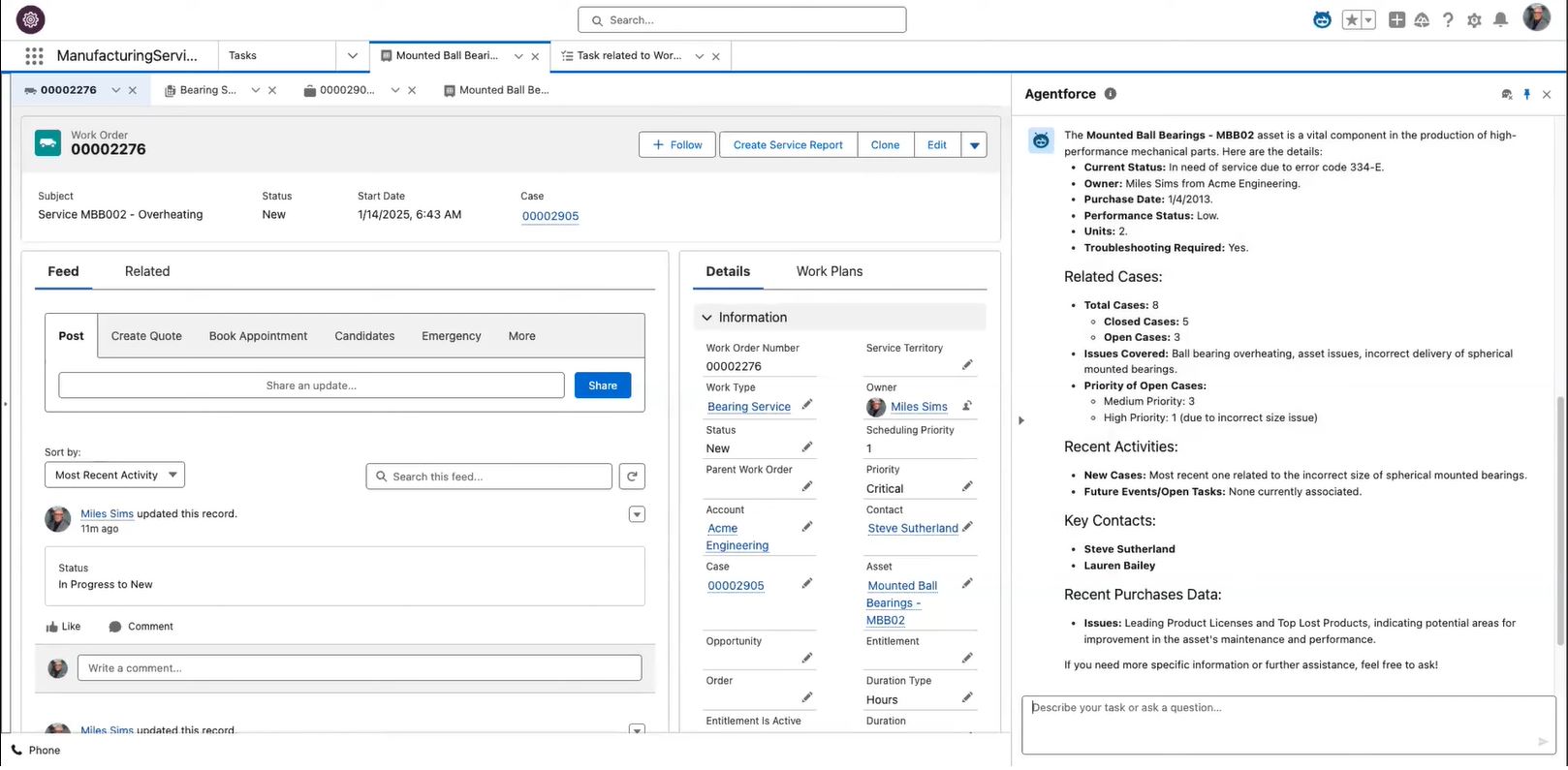
Contextual Asset Insights in Salesforce Field Service
Metric 2: First-Time Fix Rate (Work Order Accuracy)
Key question: Can Agentforce reduce rework and repeat visits?
Rework silently drains margin.
Sending the wrong technician or missing the right part often means rolling a truck twice.
In dealer-based service networks, inconsistent skill matching and incomplete job context make first-time fixes even harder.
What to measure
- Percentage of work orders resolved on the first visit
What good looks like
- 20–30% improvement in first-time fix rates within a few months
How Agentforce drives ROI
Agentforce matches technicians to jobs based on skill, certification, asset type, and historical fixes. Before work begins, it surfaces expert guidance, prior resolutions, and recommended steps.
This standardizes service quality across both OEM and partner technicians.
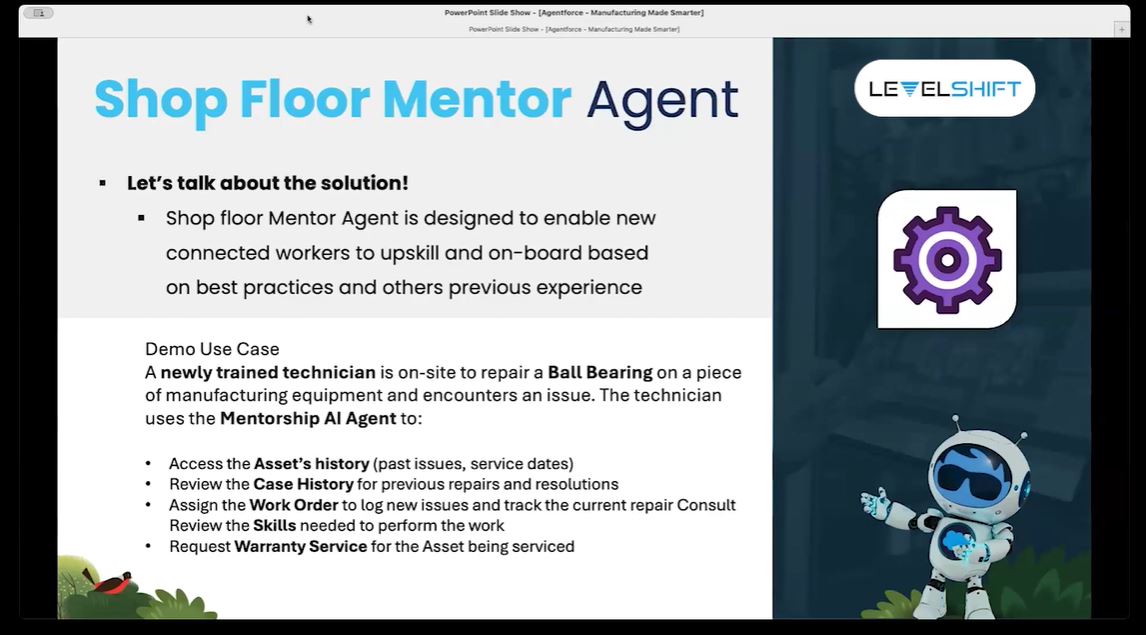
Intelligent Mentor Matching for Manufacturing Service Teams with Shop Floor Mentor Agent
Metric 3: Warranty Claim Recovery Rate
Key question: How much revenue is lost to missed or delayed warranty claims?
Many manufacturers lose millions annually because warranty claims are manual, fragmented, or never submitted, especially when service is performed by dealers.
What to measure
- Total value of recovered warranty claims versus eligible repairs
What good looks like
- 80% of warranty claim drafting automated
- Measurable increase in recovered costs
How Agentforce drives ROI
Agentforce automatically checks warranty eligibility during service execution and drafts warranty claim emails using work order data.

Agentforce automating warranty workflows in Salesforce 1.1

Agentforce automating warranty workflows in Salesforce 1.2
Metric 4: Field Service Digital Labor Hours Reclaimed
Key question: How many administrative hours can AI realistically eliminate?
Technicians and supervisors lose hours every week updating statuses, documenting work, creating follow-up tasks, and notifying stakeholders.
This admin burden grows in multi-partner environments with inconsistent reporting standards.
What to measure
- Manual administrative hours per technician or supervisor per week
What good looks like
- 5–10 hours reclaimed per supervisor each week
How Agentforce drives ROI
With Agentforce Voice and task automation, technicians can simply say “update the work order to in progress” or “create a follow-up task.” Agentforce updates Salesforce in the background.

Agentforce Voice working with Salesforce Service Cloud
Metric 5: Mean Time to Repair (MTTR)
Key question: Does Agentforce actually reduce downtime?
Uptime remains the ultimate KPI for customer-facing assets. Predictive insights only matter if technicians can act immediately.
What to measure
- Mean Time to Repair (MTTR)
- Total downtime per incident
What good looks like
How Agentforce drives ROI
Through Dynamic Work Order Guidance, Agentforce provides recommended steps, performance summaries, and contextual diagnostics the moment a case is opened. This eliminates diagnostic lag and accelerates the transition from issue detection to resolution.
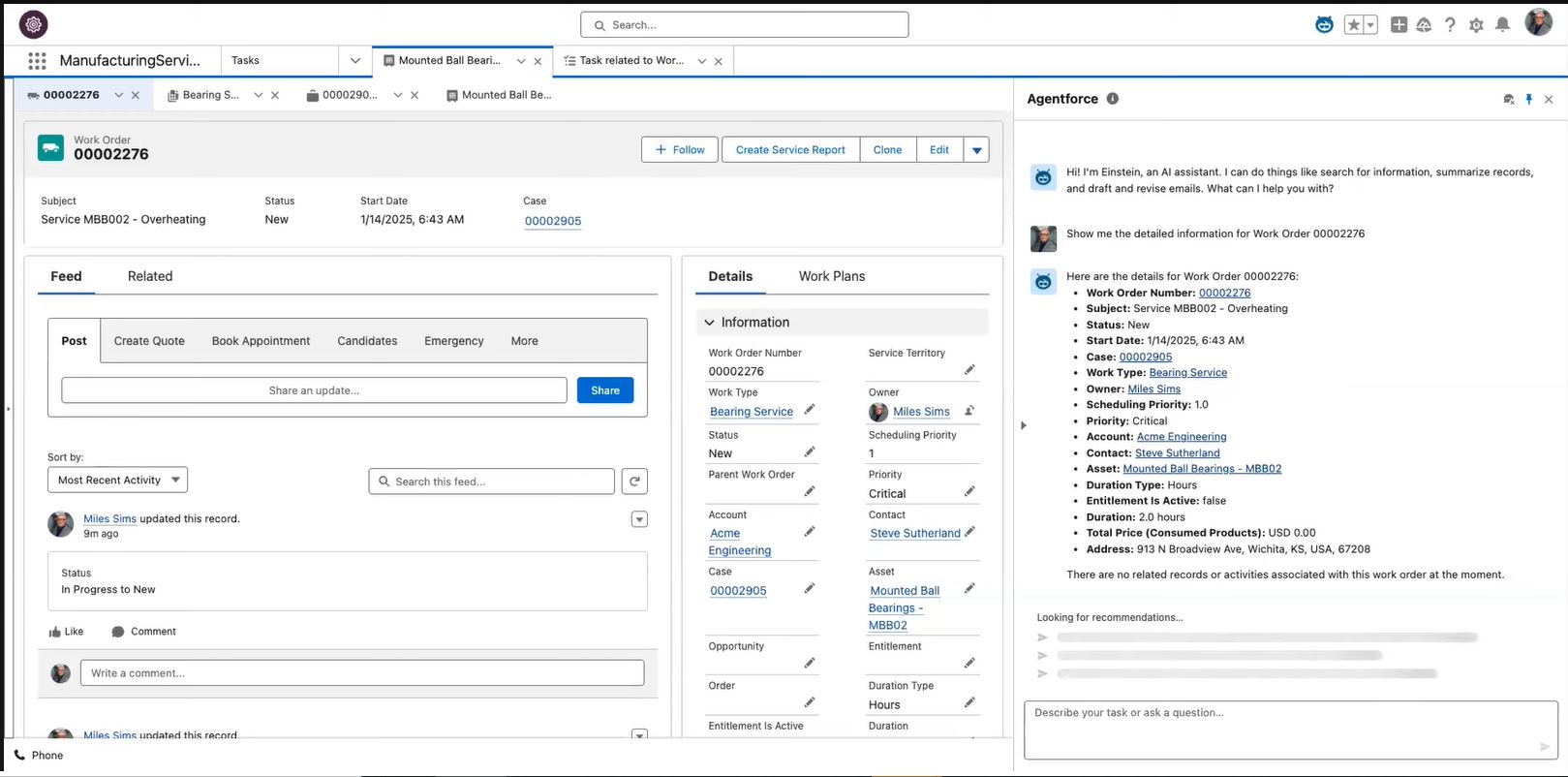
Dynamic Work Order Guidance for Manufacturing in Salesforce
Watch now: Check out our expert-led webinar for a complete view of Agentforce use cases in manufacturing.
Why Generic AI Fails in Manufacturing Field Service
Manufacturing field service environments supporting customer-owned assets are complex, regulated, and distributed.
ROI breaks down when Agentforce is deployed generically, without aligning to real-world field service models.
Top-performing manufacturers focus on:
- Specialized agents for service, assets, warranty, and scheduling
- Shared operational context through Salesforce Data Cloud
- Clear ownership of field service KPIs like MTTR, First-Time Fix, and warranty recovery
- Consistent execution across dealer and partner ecosystems
This is what turns Agentforce from an AI feature into a real operational advantage.
Moving from AI Plans to Field Service ROI
Agentforce works when it’s embedded directly into day-to-day field service workflows.
When implemented correctly, manufacturers see:
- Faster technician decisions
- Fewer repeat visits
- Better warranty recovery
- Less administrative work
- Higher asset uptime
If you’re evaluating Salesforce Agentforce for manufacturing field service, these metrics are your proof.
Not demos. Not hype. Just numbers.
Ready to Move from Roadmap to ROI?
→ Talk to a Salesforce Agentforce expert
FAQ
What is Agentforce in Salesforce manufacturing?
Agentforce is Salesforce’s AI agent framework that enables task-specific agents to operate across Service Cloud, Field Service, and Data Cloud to automate decisions and actions in manufacturing field service environments.
How do manufacturers measure ROI from Agentforce?
Manufacturers track metrics such as MTTR reduction, first-time fix rates, reclaimed admin hours, warranty recovery, and time-to-information within Salesforce Field Service.
Can Agentforce support dealer and partner technicians?
Yes. Agentforce is designed to standardize service execution across OEM, dealer, and distributor networks using shared asset data, work orders, and contextual guidance.