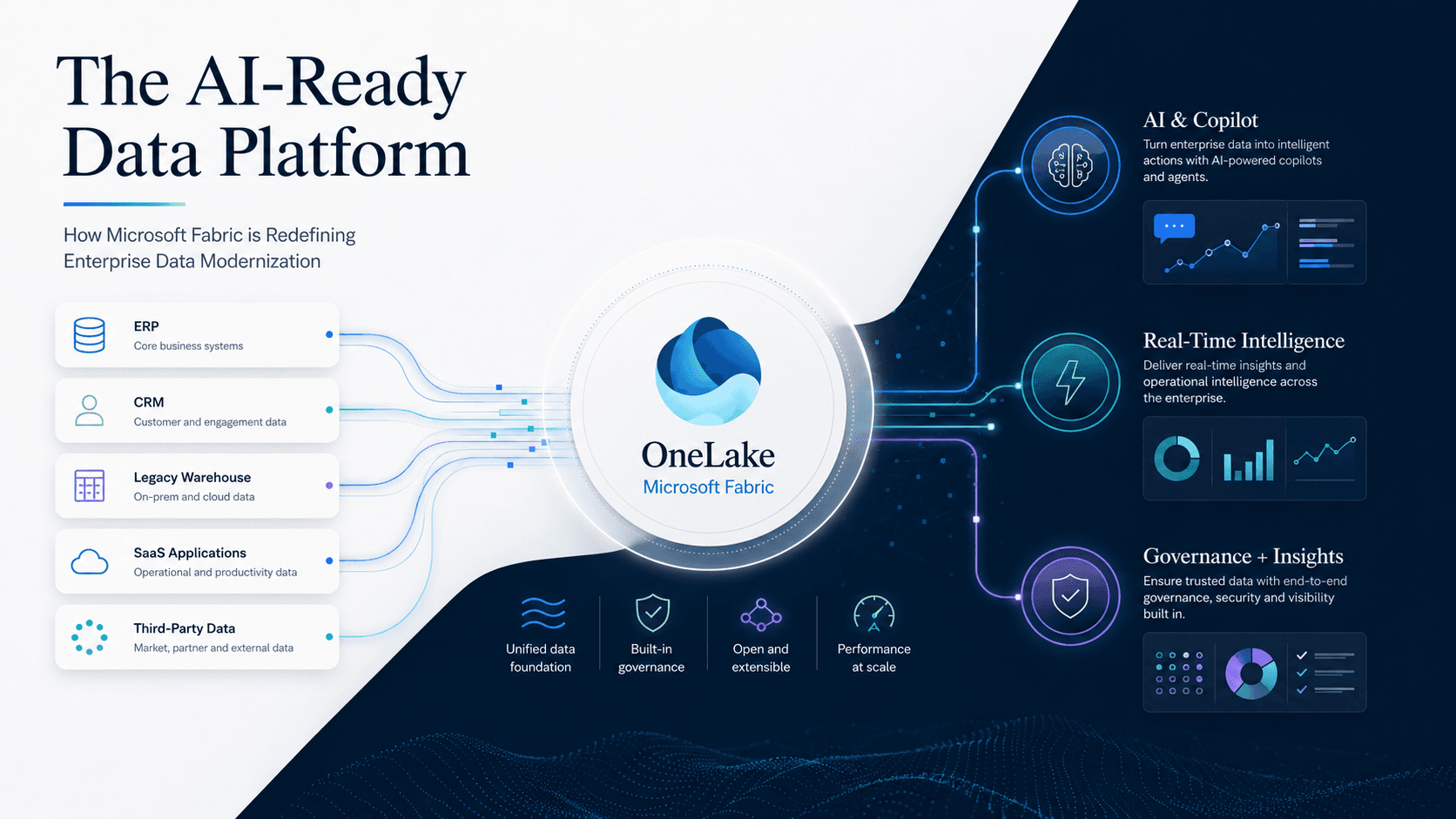
You moved to Microsoft Fabric to eliminate data silos. Data that once lived across separate data warehouses, lakes, pipelines, and analytics environments now sits within a single governed platform, and reporting is faster than it used to be. So why does it still feel like your teams spend more time finding answers than acting on them?
This is the gap most enterprises hit a year or so into Fabric. The platform is unified, but the intelligence layer on top of it is still doing what dashboards have always done, which is telling you what already happened. The next phase of value does not come from another report. It comes from systems that understand your business context, reason across your data, and take action on their own. Microsoft Fabric was built to support this evolution, bringing together a governed semantic foundation through ontology, embedded intelligence with Fabric IQ, and AI agents that can reason over data and automate business processes.
This blog explores the three capabilities that move a Fabric estate from passive reporting to intelligent automation, along with the data, governance, and implementation best practices that enable successful adoption and long-term business value.
Ontology: Giving Your Data a Business Brain
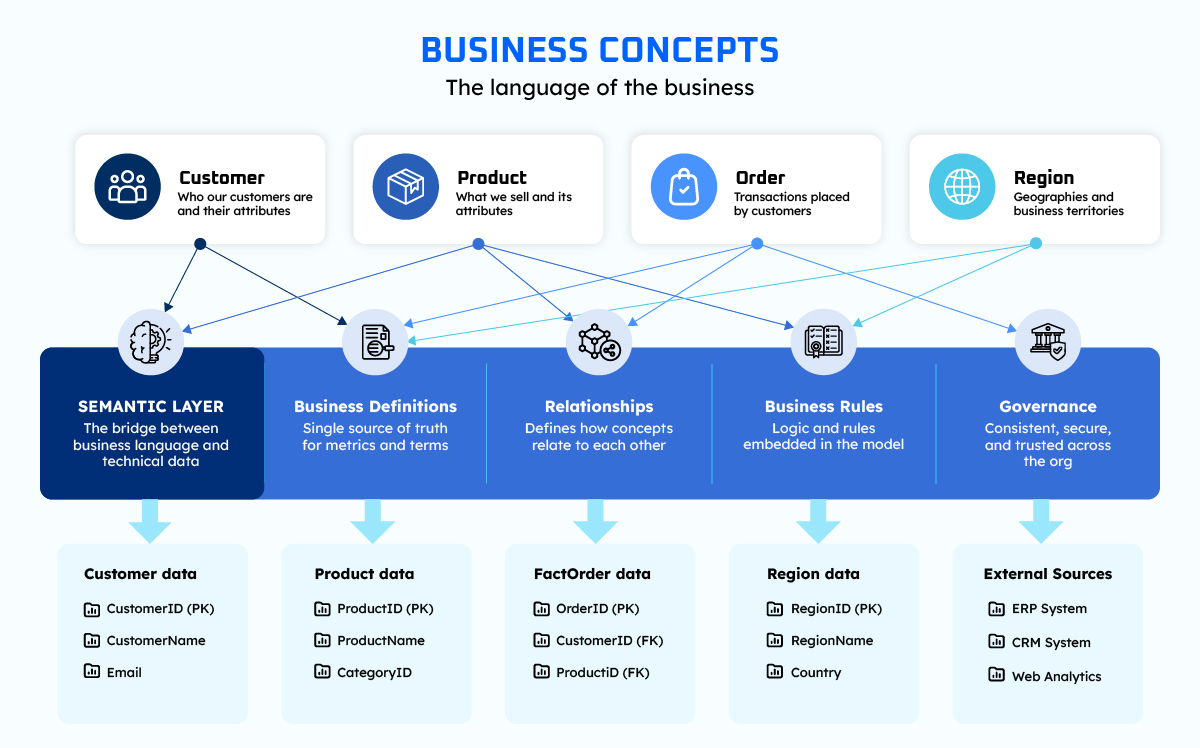
Before an AI agent can act on your data, it has to understand what your data means. That is what an ontology does. An ontology is a structured layer that defines how your core business concepts, customers, products, orders, and regions relate to each other, and then maps those concepts to the actual tables and columns underneath. Think of it as a shared vocabulary that sits between business language and technical data models.
Here is why this matters more than it sounds. When you ask an agent about revenue, it has to know whether you mean gross or net, which table holds the truth, and what date grain applies. Without a defined semantic layer, the agent guesses, and a guess at the executive level is a liability. Ontology removes that ambiguity by giving every agent and every user one governed definition to work from.
What this gives an enterprise in practice:
- Natural language querying without misinterpretation, so a business user can ask a question in plain English and trust the answer is built on the right logic
- Business rules encoded directly into the model, where a definition like “an active customer has purchased in the last 90 days” lives once and applies everywhere
- Versioned, governed, and reusable semantics through Fabric’s semantic model capabilities, so a definition can evolve without breaking everything downstream
- A smaller last-mile problem, because agents do not need retraining every time the business changes a definition
- Confident self-service for non-technical stakeholders who no longer depend on a data team to interpret a number for them
The strategic point is this. Many AI initiatives stall not because of weak models but because of inconsistent or undefined business semantics in the underlying data and Gartner predicts that organizations prioritizing semantics will increase their AI agent accuracy by up to 80% and slash data costs by up to 60%. Ontology is where you fix that, and it is the foundation everything else in this blog depends on.
Fabric IQ is Microsoft’s embedded intelligence layer within Fabric. It brings generative AI, machine learning, and intelligent automation directly into the data engineering and analytics workflows your teams already use. This is the part that sets it apart. Fabric IQ is not a separate product you integrate and maintain. It lives inside every workload, so the intelligence shows up where the work already happens.

Source: Microsoft
That distinction carries real weight for anyone who has built an AI capability the old way. Traditional platforms forced you to stitch together a warehouse here, an ML platform there, and an orchestration layer somewhere else, then maintain the seams between them forever. Fabric IQ collapses that complexity by treating intelligence as a native part of the data platform itself.
For an enterprise already running Fabric, this changes what your existing teams can do:
- It powers natural language interfaces across notebooks, reports, and pipelines, so people interact with data in the tools they already work in
- It enables AI-assisted data engineering, auto-generating transformations, flagging data quality issues, and recommending optimizations your engineers would otherwise hunt for manually
- It connects to Azure OpenAI Service, so you get enterprise-grade AI with the security and compliance controls already built into your tenant
- It improves with your context over time, getting sharper as it ingests more of your semantic metadata
- It closes the gap between preparing data and acting on it, cutting your time to insight
The way to think about Fabric IQ is less as a feature to switch on and more as a shift in posture. Intelligence becomes ambient in your data platform rather than an afterthought you build later. The organizations getting the most from Fabric are the ones treating it that way.
Data Agents and Operational Agents: Two Ways to Put Intelligence to Work
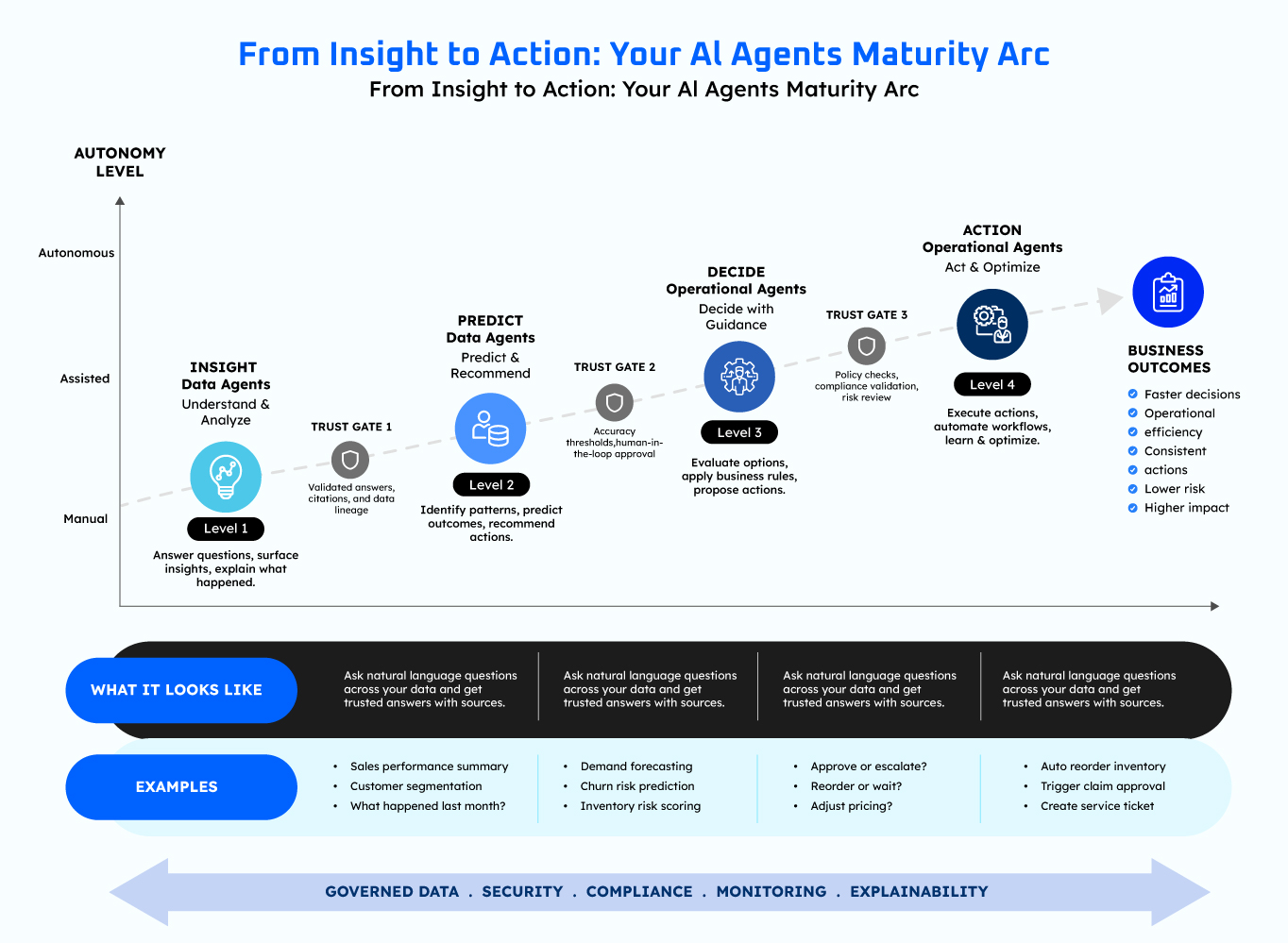
Fabric supports two complementary kinds of AI agents, and understanding the difference is what lets you adopt them at a pace your risk tolerance can handle.
Data Agents reason over the governed data in your Fabric estate, spanning lakehouses, warehouses, Power BI semantic models, and KQL databases. They answer complex questions, surface trends, and generate insights on demand. A supply chain analyst can simply ask which SKUs are at risk of stockout next week and get a structured, sourced answer without writing a single query
Operational Agents go one step further. They act on what the data tells them, triggering workflows, sending alerts, updating records, or escalating to a human reviewer. Instead of just flagging that stockout risk, an operational agent can kick off the reorder workflow automatically.
The distinction matters because reading an insight is useful, while acting on it is transformative, and the two carry very different levels of risk. Fabric’s architecture lets you dial autonomy up or down based on trust, risk appetite, and how mature the use case is.
A few principles make adoption safer:
- Start with Data Agents. They are low risk and high value, which makes them the right place to build organizational confidence
- Graduate to Operational Agents as that confidence grows and the use cases prove themselves
- Lean on built-in governance. Both agent types respect Fabric’s security and permissions model, so an agent only ever sees what it is allowed to see
- Keep everything auditable. Every agent action is logged and attributable, which makes explainability a default rather than a scramble
How this plays out across functions:
| Function |
Data Agent surfaces |
Operational Agent acts |
| Finance |
A margin anomaly across product lines |
Flags the relevant purchase order for review |
| HR |
Early attrition risk signals |
Triggers a manager check-in workflow |
| Retail |
Shelf and promotion performance |
Adjusts pricing or promotion eligibility |
Where Most Enterprises Need a Partner
Here is the honest part. Ontology, Fabric IQ, and agents all rest on one condition, which is a clean, unified, and well-governed data foundation. When a Fabric environment under delivers, the cause is rarely the platform. It is usually poor capacity sizing, un-optimized pipelines, missing governance frameworks, or semantic models that were never extended for AI use. These are exactly the issues that make an ontology fragile and an AI agent unreliable.
This is where the right implementation partner changes the outcome. As a Microsoft Fabric Featured Partner, LevelShift helps organizations implement, optimize, and scale Microsoft Fabric Services with more than 50 Fabric-certified experts and over 30 end-to-end Fabric implementations behind us. We were early adopters of Fabric IQ, with hands-on experience in ontology design, semantic model development, and agent integration, which means we have already solved the problems your team would otherwise meet for the first time.
For organizations already on Fabric, that experience shows up as measurable change. With our customer, SPINX, a US convenience retailer, we built a centralized, governed data foundation that delivered 60% faster access to business insights, a 40% reduction in manual reporting effort, and a 30% improvement in data trust and consistency, all while preparing the business for AI-driven decision-making —a transformation later highlighted in an official Microsoft customer story. The foundation came first. The intelligence followed.
If your Fabric investment is reporting well but not yet acting on its own, the path to intelligent automation is shorter than you think. It starts with getting the foundation right.
Talk to our Microsoft Fabric experts about turning your data into intelligent action. Schedule a call with our team.

Hemanth Kumar Gaddale, Chief Solutions Architect at LevelShift, specializes in enterprise data platforms, business process transformation, and digital modernization. With over two decades of experience, he helps organizations modernize data estates, accelerate cloud adoption, and unlock business value through AI and analytics. Hemanth brings deep expertise across Microsoft Fabric, Power BI, Azure Data Services, enterprise integrations, and data governance, partnering with business and technology leaders to deliver scalable, insight-driven solutions.