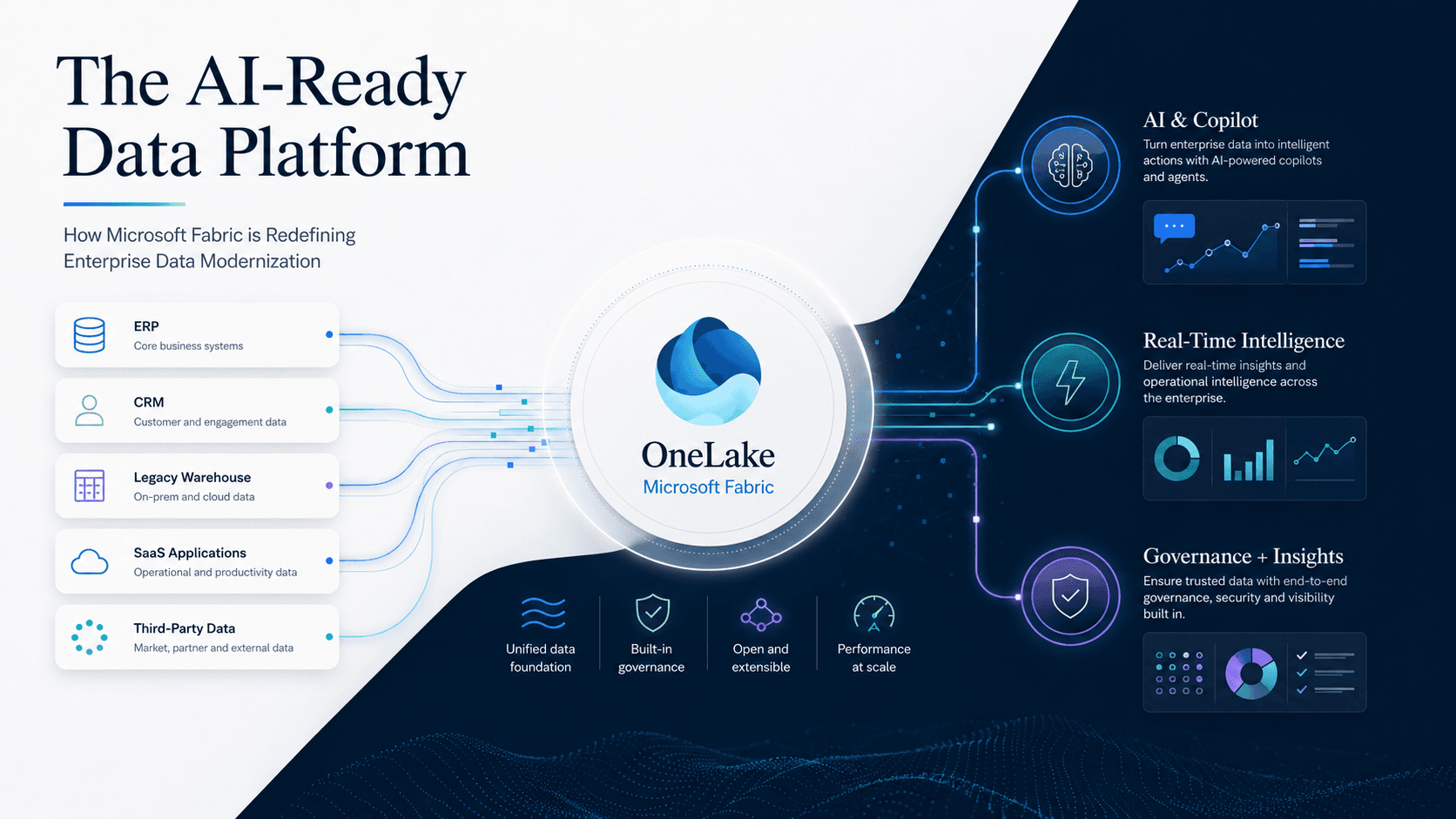
AI ambition is everywhere. AI readiness is not.
Across the enterprise, leaders are asking for faster decisions, predictive insights, intelligent automation, and copilots that can safely help teams act. Yet the reality behind many AI strategies remains fragmented: data is scattered across ERPs, CRMs, legacy warehouses, SaaS applications, operational systems, and third-party platforms.
That fragmentation creates a familiar pattern. Teams build more pipelines, duplicate more data, reconcile more reports, and spend more time debating which number is right than acting on what the data says.
This is why enterprise data transformation with Microsoft Fabric has shifted from a technology initiative to a strategic business priority. The modern enterprise does not simply need another warehouse, dashboard, or integration tool. It needs an AI-ready data platform: a trusted, governed, real-time foundation where data, analytics, and AI converge.
For organizations planning that shift, LevelShift Microsoft Fabric Services help create the foundation for AI-ready analytics, real-time intelligence, and enterprise-scale modernization.
The core issue: Data has moved, but meaning has not
Many enterprises have invested heavily in cloud platforms, analytics tools, and data engineering. But modernization often falls short because it addresses only part of the problem. Data may move faster, but it is not always easier to understand. Reports may be refreshed more often, yet definitions still vary across teams. AI pilots may launch, but the data behind them is not always trusted, governed, or reusable.
In the AI era, the winning platform is not simply the one that stores the most data. It is the one that creates a shared context for data, enabling people, dashboards, applications, copilots, and agents to interpret the same signals consistently.
The shift
The modernization question has changed from “Where should we store the data?” to “How do we turn trusted data into intelligence that the business can use?” |
Why Microsoft Fabric changes the modernization equation
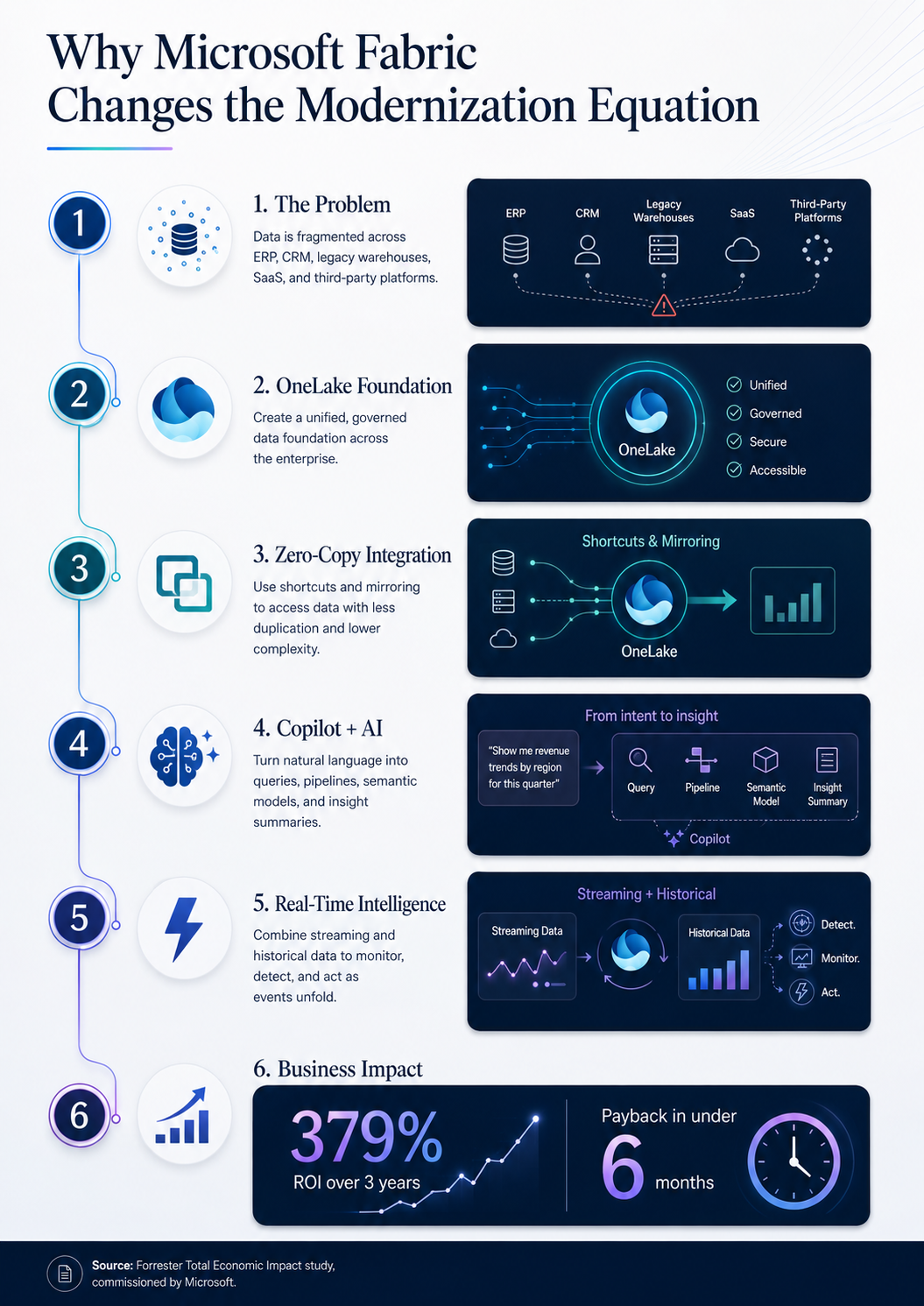
Microsoft Fabric brings together data integration, engineering, warehousing, real-time intelligence, data science, Power BI, governance, and AI assistance in a unified software-as-a-service platform. Instead of forcing enterprises to stitch together separate services and operating models, Fabric is designed around a shared foundation: OneLake.
That shared foundation matters because AI-ready modernization requires more than pipeline speed. It requires a common data layer, consistent governance, reusable semantics, real-time signals, and AI-assisted workflows that reduce friction throughout the data lifecycle.
The result is a new modernization model: less duplication, fewer disconnected tools, faster insight generation, and a stronger platform for AI adoption.
Source: Forrester Total Economic Impact study commissioned by Microsoft
At the center of Microsoft Fabric is OneLake, a single logical data lake for the enterprise. OneLake gives organizations a unified foundation where data can be stored, discovered, governed, and used across Fabric workloads without every team creating its own disconnected copy.
For business leaders, the value is not only technical simplification. It is an operating discipline. OneLake provides a consistent place for trusted enterprise data, making it easier for teams to build analytics, reporting, and AI workflows on the same foundation.
- Reduce duplication across data domains and teams.
- Create a shared foundation for analytics and AI workloads.
- Support open formats and interoperability.
- Improve data discovery, governance, and reuse across the enterprise.
Shortcuts and mirroring: Modernize without a big-bang migration
Traditional modernization programs often become large-scale migration initiatives. The risk is that value is delayed as teams focus on moving data before they can use it. Fabric offers a more practical path through capabilities such as OneLake shortcuts and mirroring.
Shortcuts allow teams to access data where it already resides, while mirroring supports low-friction replication of operational data into OneLake for analytics. This helps enterprises modernize incrementally, connect existing systems, and reduce the need for excessive data movement. This is the core promise of Data Modernization with Microsoft Fabric: start where you are, connect what matters, and modernize without disruption.
| Why it matters
The fastest modernization programs do not always start by moving everything. They start by making the right data usable, governed, and connected to business outcomes. |
Copilot and Fabric IQ: From trusted data to reusable intelligence
AI-powered analytics works only when the underlying platform provides trusted data, context, and governance. Microsoft Fabric supports this through embedded Copilot capabilities and the emerging semantic intelligence layer of Fabric IQ.
Copilot in Fabric can help data teams and business users accelerate common workflows, including generating SQL, creating or refining pipelines, building semantic models, and summarizing Power BI reports. Rather than relying solely on specialized technical teams for every request, users can move faster from intent to insight.
Fabric IQ extends this idea by helping to define the business meaning of data so that analytics, AI agents, and applications can work from a more consistent understanding of enterprise context. These include:
- Natural language to query and pipeline assistance
- Semantic model support to improve reusable business definitions
- Report summaries that surface trends, anomalies, and key insights
- A stronger foundation for copilots and future AI agents
Real-Time Intelligence: Moving from reporting to response
Once data is unified and AI is embedded, the next expectation is immediacy. Enterprises cannot rely only on delayed reporting when operations, customer behavior, risk signals, and market conditions are constantly changing.
Microsoft Fabric Real-Time Intelligence enables organizations to combine streaming and historical data, allowing teams to monitor events, detect anomalies, trigger alerts, and respond as conditions change. This shifts the data platform from a passive reporting layer to an active intelligence layer.
For organizations that want to operationalize this capability, LevelShift Real-Time Intelligence Services help design live analytics, event-driven monitoring, alerts, and automation patterns on Microsoft Fabric.
Governance and cost discipline: Scaling Fabric without chaos
The most successful data platforms do not scale by giving everyone unlimited tools and hoping governance will catch up later. They scale through clear standards, role-based access, capacity planning, security controls, and cost visibility.
Fabric supports enterprise-scale adoption through centralized governance and discovery via the OneLake Catalog, permission-aware AI assistance, security controls, and platform-level administration. For modernization leaders, this creates a practical path to scale AI-ready analytics while preserving trust and control.
- Define data ownership and domain responsibilities.
- Standardize naming, security, and access patterns.
- Use capacity planning and FinOps practices to manage cost.
- Create adoption playbooks for business users, data teams, and platform teams.
| Old modernization model |
AI-ready Fabric model |
Business impact |
| Data copied across tools and teams |
Data unified through OneLake, shortcuts, and mirroring |
Less duplication and faster access to trusted data |
| Dashboards built after long development cycles |
Copilot-assisted workflows and reusable semantic models |
Faster path from question to decision-ready insight |
| Batch-only reporting and delayed operational visibility |
Real-time and historical analytics in one platform |
Faster monitoring, anomaly detection, and response |
| Governance managed separately from analytics adoption |
Built-in governance, discovery, and permission-aware experiences |
Higher trust, stronger compliance, and scalable adoption |
| AI pilots disconnected from enterprise data strategy |
AI-ready data foundation connected to business priorities |
More practical route from AI experimentation to business value |
How LevelShift helps enterprises move from Fabric interest to Fabric impact
Microsoft Fabric provides the platform. Value comes from how it is planned, implemented, governed, and adopted. Many organizations know they need a modern, AI-ready data foundation, but they still need a clear roadmap for where to start, what to migrate, what to connect, and which business outcomes to prioritize.
LevelShift helps enterprises move from strategy to scale through a structured Fabric modernization approach.
- Assess and prioritize: Evaluate the current data estate, identify use cases, define readiness gaps, and develop a roadmap aligned with measurable business outcomes.
- Unify and integrate: Establish the OneLake foundation, connect source systems, simplify access through shortcuts and mirroring, and reduce unnecessary duplication.
- Activate AI and self-service: Enable Copilot, analytics, semantic models, and AI-ready pipelines so teams can move from raw data to decision-ready insights faster.
- Govern and scale: Apply security, cost controls, operating standards, adoption playbooks, and governance patterns to scale confidently.
Organizations seeking a practical starting point can begin with LevelShift’s Microsoft Fabric Assessment and Advisory Services, which include readiness, roadblock, and ROI-focused assessment paths.

Framework: Four moves to build an AI-ready data platform.
The business case for moving now
The case for Fabric is not just architectural; it is also economic. A Forrester Total Economic Impact study commissioned by Microsoft found that a composite organization using Microsoft Fabric achieved a 379% ROI over three years with payback in less than six months.
Those numbers should not be taken as a guarantee for every enterprise, but they demonstrate the potential value of consolidating data tools, reducing integration complexity, improving data-team productivity, and accelerating time to insight.
| Executive takeaway
The organizations that modernize fastest will not be the ones with the most data. They will be the ones that can turn trusted data into governed, real-time, AI-powered action. |
The path forward
Enterprise leaders now face a clear choice: continue investing in fragmented systems or build a unified foundation for analytics, AI, and real-time decision-making.
Data modernization with Microsoft Fabric provides organizations with a practical path to unify data, simplify modernization, enable AI-powered analytics, and scale governance across the enterprise. But successful adoption requires more than turning on the platform. It requires a clear strategy, high-value use cases, the right architecture, and disciplined execution.
If your organization plans to modernize its data platform and build an AI-ready foundation, connect with LevelShift experts to explore how Microsoft Fabric can accelerate your transformation.