It’s ubiquitous. Everyone’s talking about Agentic RAG. It’s widely regarded as the future of RAG. But what does it actually mean? More importantly, why does it matter?
Before we get to that, let’s first understand RAG. If your organization has invested in AI, you’ve probably already come across it. RAG is the classic retrieval-augmented approach that has become the foundation of many AI applications. Most people now call this Classic RAG, to set it apart from what comes next. Here is what it actually does, and where it starts to run out of road.
What Classic RAG Actually Does
RAG has become table stakes for enterprise AI. Any serious deployment now assumes it. Classic RAG follows a simple path. A user asks a question, the system searches a vector store for related chunks of text, and the model turns those chunks into an answer. This retrieve-then-generate loop replaced a bigger problem: language models that guessed at facts instead of checking them. Pure LLMs hallucinate. RAG fixed that by giving the model something real to work from, whether that is a policy document, a product manual, or a support ticket.
For simple lookups, Classic RAG works well. Ask it to summarize a document or pull one fact from a knowledge base, and it delivers. Ask it something layered, like your Q3 revenue in APAC among customers who joined after a rebrand, and it starts to struggle. One search against one index cannot answer a question that needs several steps of reasoning strung together. That gap is where most enterprise AI projects hit a wall.
If you already run on Microsoft Fabric, this pipeline sits closer than it looks. Fabric’s SQL databases support native vector search, and Fabric integrates directly with Azure AI Search for embeddings and semantic ranking, so the vector store behind Classic RAG can live right next to the rest of your data in OneLake. That proximity matters because RAG output quality tracks retrieval quality. Clean, well-governed data retrieves better context, and better context produces better answers.
The Data Classic RAG Never Sees
Here is the harder problem most Classic RAG deployments never solve. Somewhere between 80 and 90 percent of enterprise data sits outside neat rows and columns. It lives in contracts, support tickets, call transcripts, emails, and scanned forms. That unstructured layer holds most of the signal about customer sentiment, competitive pressure, operational friction, and strategic risk that structured tables never capture. Your structured data tells you what happened in the business. Your unstructured data tells you why. Are you listening to both? Most Classic RAG setups only index a narrow slice of that unstructured world, so agents answer with a fraction of the full picture.
Microsoft Fabric treats this as one data problem instead of two. It ingests, indexes, and queries unstructured content right alongside structured tables, under the same governance and lineage rules, so a support ticket does not get a lower bar for data quality than a sales record. That consistency is what makes a question like “summarize every customer complaint that mentions our delivery SLA in the last 30 days” answerable at all, pulling from tickets, emails, and call transcripts in a single pass instead of three separate searches.

Where Agentic RAG Changes the Equation
Agentic RAG does not wait for one perfect search to land. It plans first, asks what the question actually requires, and only then goes looking for it. Once retrieval starts, the agent chains lookups together: find the customer, pull their contract, isolate the relevant clause, then answer the question. If the first pass comes back thin, the agent recognizes the gap and searches again with a sharper query.
This is where Fabric IQ and Foundry IQ each earn their place in the conversation. Fabric IQ gives agents a semantic layer built on top of OneLake, a shared business vocabulary where customer, revenue, or region mean the same thing across every report, notebook, and agent that touches them. Foundry IQ is where the agentic retrieval actually runs. It plans the query, searches iteratively across Fabric IQ and other connected sources, and reflects on whether the results are complete before returning an answer. Together, they let agents’ reason across structured tables and unstructured documents in the same query, while respecting the row-level security and workspace permissions your teams already rely on.
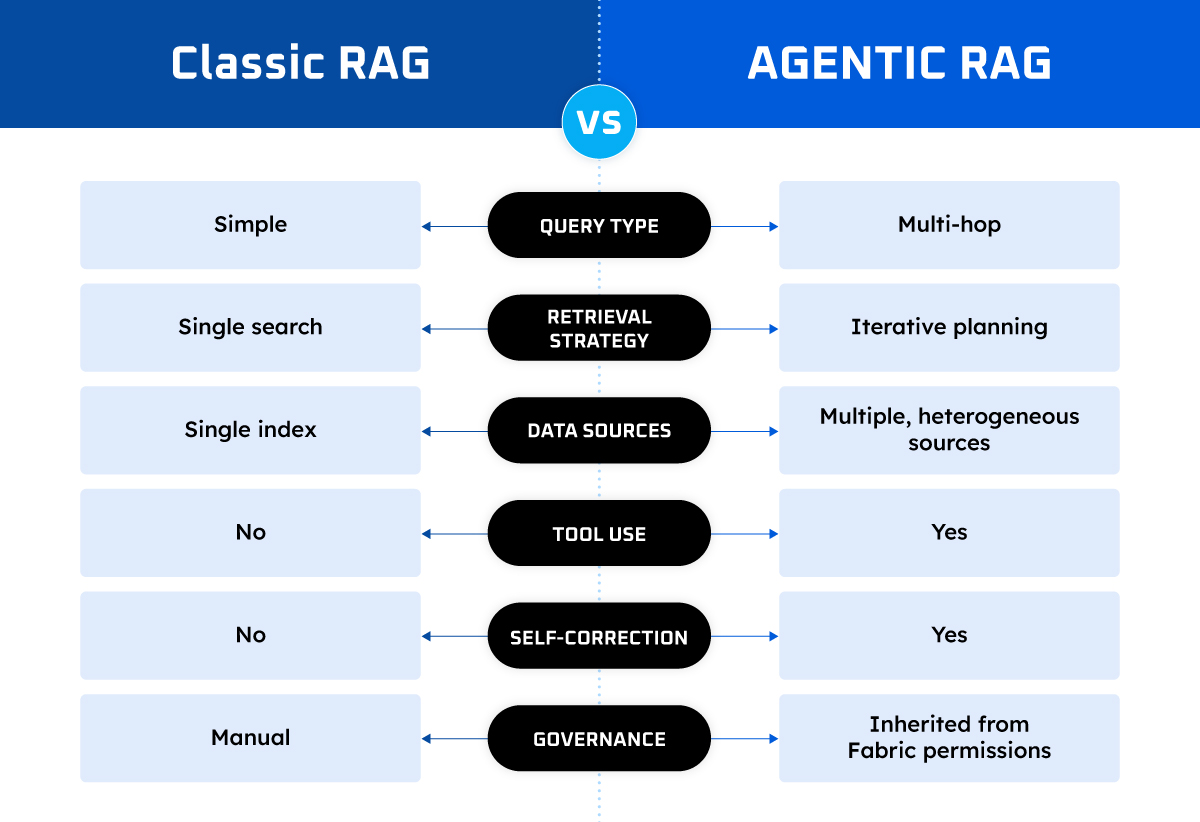
A few things separate the two approaches in practice:
| Capability |
Classic RAG |
Agentic RAG |
| Single vector search against one index |
✅ |
❌ |
| Plans before retrieving |
❌ |
✅ |
| Iterative search across multiple, heterogeneous sources |
❌ |
✅ |
| Calls tools mid-reasoning (APIs, live databases, calculators) |
❌ |
✅ |
| Handles straightforward, single-source questions well |
✅ |
✅ |
| Handles multi-hop questions spanning several sources |
❌ |
✅ |
| Stops once a response is generated |
✅ |
❌ |
| Checks its own output and re-queries if context falls short |
❌ |
✅ |
| Governance sits outside the pipeline |
✅ |
❌ |
| Governance inherited from the platform (Purview policies and permission boundaries) |
❌ |
✅ |
One more difference matter for governance teams. Agentic systems are built to be observable. Every retrieval step and reasoning pass can be logged, so compliance and audit teams can trace exactly how an agent reached its answer, not just what it said.
Why This Is Not a Flip-of-a-Switch Upgrade
None of this happens by turning on a setting. Agentic RAG needs a foundation: clean data in one place, a semantic model agents can reason over, and governance that scales with agent access instead of trailing behind it. Gartner projects that through 2026, organizations will abandon 60 percent of AI projects that lack AI-ready data. Enterprises that jump straight to agents without fixing the data foundation underneath end up with expensive pilots that never reach production.
Microsoft Fabric closes that gap. OneLake gives every workload, structured or unstructured, a single governed home instead of scattered copies across tools. Document intelligence extracts structured insight from contracts and forms automatically. Fabric IQ adds the ontology and semantic models agents need to stay accurate and consistent. Organizations that make this move report a 379 percent ROI over three years, according to Forrester’s research on Fabric adoption. The platform gives Agentic RAG somewhere solid to stand.
Why Enterprises Bring in a Partner for This Shift
Building that foundation takes real technical depth. It takes people who have designed ontologies, tuned semantic models, and connected agents to live data without breaking governance along the way. That is where LevelShift comes in.
As a Microsoft Fabric Featured Partner with more than 50 Fabric-certified experts and 30-plus end-to-end implementations, we help enterprises move from scattered data to agent-ready data. Our 3R Assessment framework evaluates readiness, roadblocks, and ROI, so gaps in your data foundation surface before you invest further in Agentic RAG. As early adopters of Fabric IQ, our team works directly on ontology design, semantic models, and agent integration, the exact groundwork Agentic RAG depends on.
Agentic RAG is not a distant idea. It is capability enterprises build on Foundry IQ, with Fabric as the data foundation underneath. If your organization is ready to move past Classic RAG’s limits, talk to our Fabric experts and find out what an agent-ready data foundation looks like for your business.