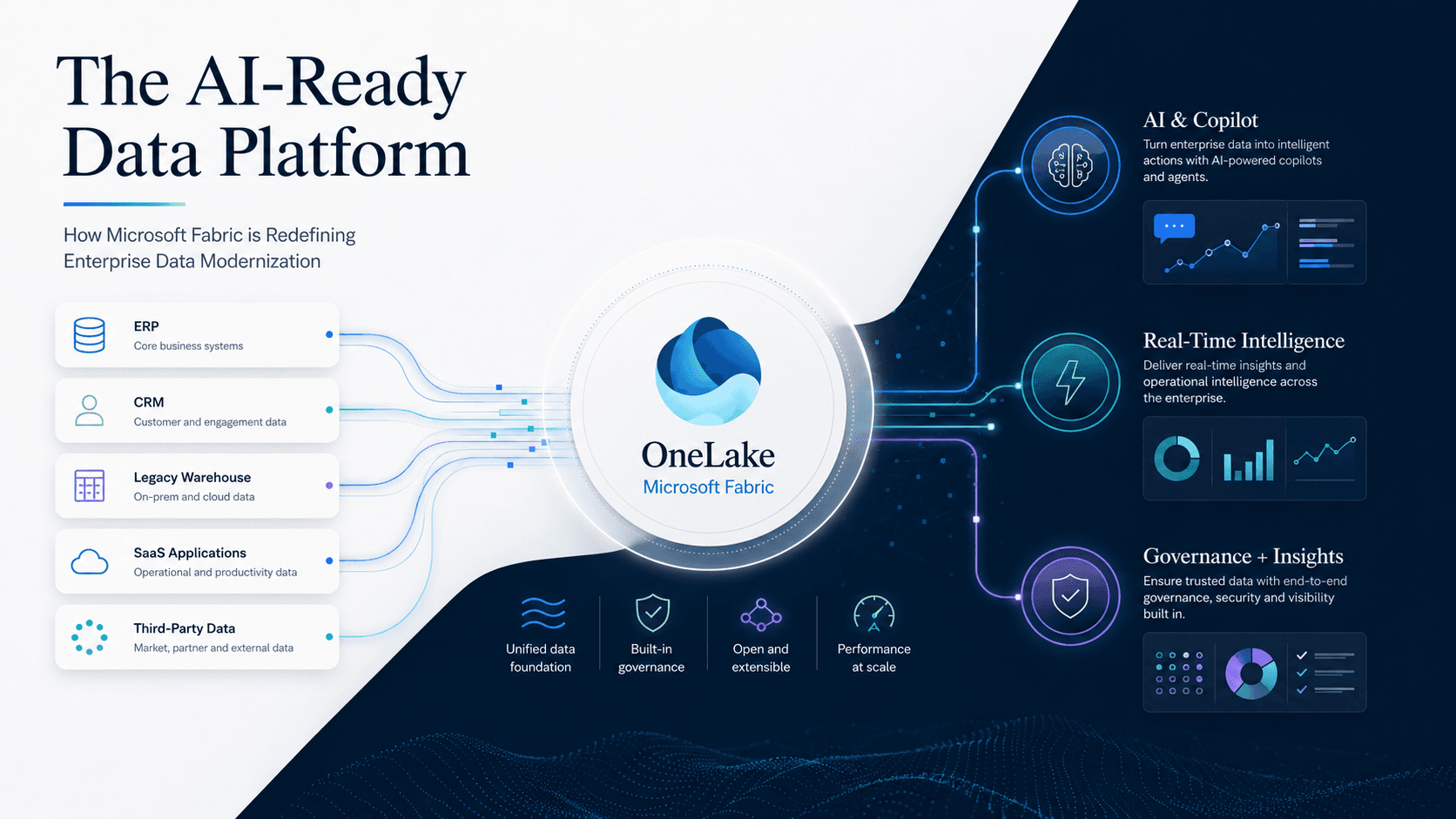
Many organizations running Azure Synapse Analytics face the growing challenge of managing fragmented tools like Synapse SQL Pools, Spark, Data Factory, and Data Lake Storage. While Azure provides flexibility and scalability, disconnected services can lead to rising costs, integration headaches, and slower time-to-insight.
Microsoft Fabric changes the game by unifying your Synapse-driven data estate into a single, AI-ready SaaS platform. LevelShift helps Synapse customers modernize their environment, reduce complexity, and simplify insights with a structured migration to Microsoft Fabric.
In this blog, we break down the following:
- Technical limitations of Azure Synapse Analytics
- How Microsoft Fabric resolves those issues
- Pricing and licensing details
- Key personas and industries that benefit
- AI and Copilot advantages
- Governance and security improvements
It also delves into the technical aspects of transitioning from Azure’s legacy frameworks to Microsoft Fabric, highlighting architectural considerations, data flow transformations, governance enhancements, and the infusion of AI capabilities.
Technical Limitations of Traditional Synapse-centric Azure Environments
Azure Synapse Analytics and its supporting services deliver powerful analytics, but businesses often face these challenges:
- Fragmented Data Silos: Managing Synapse SQL, Spark, Data Factory, and storage separately leads to disconnected datasets and slower insights.
- Complex Data Pipelines: Orchestrating Synapse and Data Factory pipelines across multiple environments increases maintenance, error risk, and development time.
- Inconsistent Governance: Applying unified security, lineage tracking, and compliance across Synapse, Data Factory, and Data Lake Storage requires significant manual effort.
- Scaling Constraints: Scaling Synapse and related tools independently creates inefficiencies, performance bottlenecks, and unnecessary costs.
- Overlapping Licenses: Azure’s separate pricing for Synapse, Data Factory, and storage adds to administrative complexity and unpredictable expenses.
Orchestrating seamless data flows across these siloed components demands significant custom development and ongoing maintenance. This fragmentation often results in data duplication, inconsistent metadata, and increased storage costs.
Furthermore, enterprises lack a unified monitoring layer, making it difficult to track data lineage, pipeline health, and performance metrics across disparate tools. The pay-as-you-go pricing model, although flexible, can lead to cost leakage due to loosely coupled services and overlapping resources. Security and governance also present ongoing hurdles, as RBAC, audit trails, and data policies must be manually configured and maintained across each service.
How Microsoft Fabric solves Synapse challenges
Organizations with heavy Synapse, Data Factory, and Azure Data Lake dependencies benefit the most by modernizing to Fabric. It offers:
- OneLake: Fabric’s unified storage layer integrates Synapse-linked Data Lake, eliminating silos and reducing data duplication.
- Integrated Workloads: SQL, Spark, Data Pipelines, and Real-Time Analytics operate within one governed, AI-ready environment.
- Built-In Governance: Fabric centralizes data security, lineage, and compliance using Microsoft Purview and Azure AD integrations.
- Elastic Scalability: Fabric optimizes performance and cost with dynamic scaling of storage, compute, and real-time workloads.

Why Shifting to Microsoft Fabric is a Wise Move
Microsoft Fabric offers a cleaner architecture, lower total cost of ownership (TCO), built-in AI, and simplified governance while remaining deeply integrated with the Microsoft ecosystem you already use.
| Fabric Component |
Replaces/Enhances |
Key Benefit |
| Fabric Data Pipelines |
Azure Data Factory |
Unified orchestration, real-time monitoring |
| Fabric Data Warehouse |
Synapse Dedicated SQL Pools |
Scalable, cost-efficient lake-centric compute |
| Fabric Lakehouse & Spark |
Synapse Spark |
Collaborative, low-code notebooks with unified storage |
| OneLake |
ADLS Gen2 |
Centralized storage, shortcut-enabled access |
| Fabric Real-Time Analytics |
Event Hubs, IoT Streams |
Native, scalable real-time insights |
| Power BI (Integrated) |
Power BI Standalone |
Embedded reporting and live dashboards |
| Fabric Copilot & AI |
Azure ML & External AI integrations |
Simplified, AI-infused pipelines |
Licensing and Pricing Simplified
Fabric offers capacity-based licensing that simplifies operations compared to managing individual Synapse, Data Factory, and Power BI SKUs.
| Fabric SKU |
Monthly Price (Est.) |
Use Case |
| F2 Capacity |
~$262 |
Development and testing workloads |
| F64 Capacity |
~$8,389 |
Enterprise-grade analytics and production workloads |
| Power BI Pro |
$10/user |
Secure collaboration and publishing |
| Premium Capacity (Fabric) |
Starts at $4,995 |
Required for advanced Fabric workloads |
Note: Licenses can be purchased via the Azure portal or Microsoft 365 Admin Center. LevelShift helps right-size your Fabric capacity with our ROI assessment tools.
Key Personas and Industries that Benefit from Synapse to Fabric Migration
Here are several common use cases.
| Persona |
Fabric Advantage |
| Data Engineers |
Simplified pipeline migration, unified monitoring |
| Data Scientists |
AI-ready environment with Spark, SQL, and notebooks |
| BI Analysts |
No-copy access to real-time data models and reports |
| IT Admins |
Centralized governance, security, and lineage |
| CIOs/CTOs |
Reduced TCO, faster innovation, AI-enabled architecture |
What’s your Microsoft Fabric usecase? We can help you with a solution
Why Choose LevelShift for Your Azure-to-Fabric Shift
Azure Synapse environments often become complex, fragmented, and hard to govern. LevelShift helps you simplify and modernize with expert assessments, phased Fabric migration plans, built-in governance, and ongoing optimization — all backed by Microsoft-recognized expertise in Synapse, Analytics, and Data Platform transformation. The blog summarizes what Microsoft Fabric is and explores the business and technical case for migration.
As a Microsoft Fabric consulting company with deep experience in Azure and Fabric:
- We assess your existing Azure workloads and provide a Fabric Readiness Report.
- Help build a phased migration roadmap that includes Synapse, Data Factory, and other relevant systems.
- Implement governance-first frameworks to meet compliance.
- Offer additional data compliance services to maximize Fabric ROI.
- Provide ongoing managed services post-migration.
We have also earned specializations in Azure Analytics and Azure Data Warehouse migration in addition to being a Microsoft Solutions partner for Data and AI. Our Fabric consulting services offer a simplified, unified approach to licensing and governance of data and application workflows. It resolves the silos and integration pain points that have long challenged enterprise IT teams.
Are you ready to explore the possibilities of Fabric for your Synapse environment?
🚀 Book a 1:1 Readiness Assessment with LevelShift